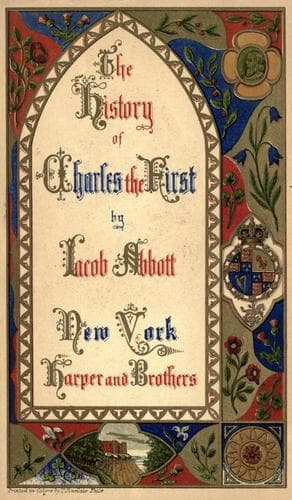
History of King Charles the First of EnglandAbbott, Jacob
History
History of King Charles the First of England
Abbott, Jacob
Charles I, King of England, 1600-1649; Great Britain -- History -- Charles I, 1625-1649; Great Britain -- Kings and rulers -- Biography
Another method of taxation was what was called _tonnage and poundage_.
This was an ancient tax, assessed on merchandise brought into the
country in ships, like the _duties_ now collected at our custom-houses.
It was called tonnage and poundage because the merchandise on which it
was assessed was reckoned by weight, viz., the ton and the pound. A
former king, Edward III., first assessed it to raise money to suppress
piracy on the seas. He said it was reasonable that the merchandise
protected should pay the expense of the protection, and in proper
proportion. The Parliament in that day opposed this tax. They did
not object to the tax itself, but to the king's assessing it by his
own authority. However, they granted it themselves afterward, and it
was regularly collected. Subsequent Parliaments had granted it, and
generally made the law, once for all, to continue in force during the
life of the monarch. When Charles commenced his reign, the Peers were
for renewing the law as usual, to continue throughout his reign. The
Commons wanted to enact the law only for a year at a time, so as to
keep the power in their own hands. The two houses thus disagreed, and
nothing was done. The king then went on to collect the tax without any
authority except his own prerogative.
[Sidenote: Ship money.]
[Sidenote: Origin of these taxes.]
Another mode of levying money adopted by the king was what was called
_ship money_. This was a plan for raising a navy by making every town
contribute a certain number of ships, or the money necessary to build
them. It originated in ancient times, and was at first confined to
seaport towns which had ships. These towns were required to furnish
them for the king's service, sometimes to be paid for by the king, at
other times by the country, and at other times not to be paid for at
all. Charles revived this plan, extending it to the whole country; a
tax was assessed on all the towns, each one being required to furnish
money enough for a certain number of ships. The number at one time
required of the city of London was twenty.
[Sidenote: 1636.]
[Sidenote: John Hampden.]
[Sidenote: He refuses to pay ship money.]
Public-domain text, read in full here on John Shaqi.
Reviews
Reviews
No reviews yet
Be the first to share your thoughts on this work.
Elsewhere in the archive
Join the Discussion
Join the discussion
Sign in to leave a comment or review.
Sign InorCreate an account