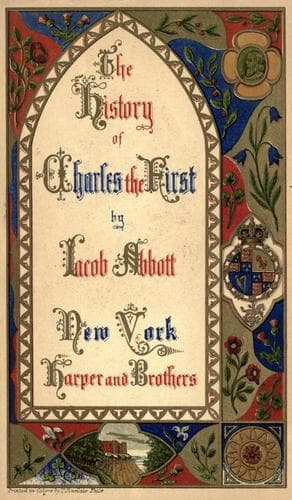
History of King Charles the First of EnglandAbbott, Jacob
History
History of King Charles the First of England
Abbott, Jacob
Charles I, King of England, 1600-1649; Great Britain -- History -- Charles I, 1625-1649; Great Britain -- Kings and rulers -- Biography
Laud employed the power of the Star Chamber a great deal in the
accomplishment of his purpose of enforcing entire submission to the
ecclesiastical authority of the Church. He even had persons sometimes
punished very severely for words of disrespect, or for writings in
which they censured what they considered the tyranny under which they
suffered. This severe punishment for the mere expression of opinion
only served to fix the opinion more firmly, and disseminate it more
widely. Sometimes men would glory in their sufferings for this cause,
and bid the authorities defiance.
[Sidenote: Case of Lilburne.]
[Sidenote: His indomitable spirit.]
One man, for instance, named Lilburne, was brought before the Star
Chamber, charged with publishing seditious pamphlets. Now, in all
ordinary courts of justice, no man is called upon to say any thing
against himself. Unless his crime can be proved by the testimony of
others, it can not be proved at all. But in the Star Chamber, whoever
was brought to trial had to take an oath at first that he would answer
all questions asked, even if they tended to criminate himself. When
they proposed this oath to Lilburne, he refused to take it. They
decided that this was contempt of court, and sentenced him to be
whipped, put in the pillory, and imprisoned. While they were whipping
him, he spent the time in making a speech to the spectators against the
tyranny of bishops, referring to Laud, whom he considered as the author
of these proceedings. He continued to do the same while in the pillory.
As he passed along, too, he distributed copies of the pamphlets which
he was prosecuted for writing. The Star Chamber, hearing that he was
haranguing the mob, ordered him to be gagged. This did not subdue him.
He began to stamp with his foot and gesticulate; thus continuing to
express his indomitable spirit of hostility to the tyranny which he
opposed. This single case would be of no great consequence alone, but
it was not alone. The attempt to put Lilburne down was a symbol of
the experiment of coercion which Charles in the state, and Laud in the
Church, were trying upon the whole nation; it was a symbol both in
respect to the means employed, and to the success attained by them.
[Sidenote: The young lawyers' toast.]
[Sidenote: Ingenious plea.]
Public-domain text, read in full here on John Shaqi.
Reviews
Reviews
No reviews yet
Be the first to share your thoughts on this work.
Elsewhere in the archive
Join the Discussion
Join the discussion
Sign in to leave a comment or review.
Sign InorCreate an account