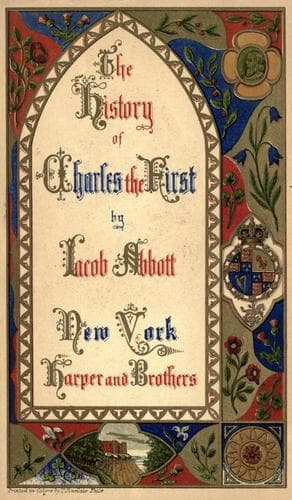
History of King Charles the First of EnglandAbbott, Jacob
History
History of King Charles the First of England
Abbott, Jacob
Charles I, King of England, 1600-1649; Great Britain -- History -- Charles I, 1625-1649; Great Britain -- Kings and rulers -- Biography
There was in those days, as now, in the English Church, a certain
prescribed course of prayers, and psalms, and Scripture readings, for
each day, to be read from a book by the minister. This was called the
Liturgy. The Puritans did not like a liturgy. It tied men up, and did
not leave the individual mind of the preacher at liberty to range
freely, as they wished it to do, in conducting the devotional services.
It was on this very account that the friends of strong government _did_
like it. They wanted to curtail this liberty, which, however, they
called license, and which they thought made mischief. In extemporaneous
prayers, it is often easy to see that the speaker is aiming much more
directly at producing a salutary effect on the minds of his hearers
than at simply presenting petitions to the Supreme Being. But,
notwithstanding this evil, the existence of which no candid man can
deny, the enemies of forms, who are generally friends of the largest
liberty, think it best to leave the clergyman free. The friends of
forms, however, prefer forms on this very account. They like what they
consider the wholesome and salutary restraints which they impose.
[Sidenote: The Scotch.]
[Sidenote: Laud prepares them a Liturgy.]
Now there has always been a great spirit of freedom in the Scottish
mind. That people have ever been unwilling to submit to coercion or
restraints. There is probably no race of men on earth that would
make worse slaves than the Scotch. Their sturdy independence and
determination to be free could never be subdued. In the days of Charles
they were particularly fond of freely exercising their own minds, and
of speaking freely to others on the subject of religion. They thought
for themselves, sometimes right and sometimes wrong; but they would
think, and they would express their thoughts; and their being thus
unaccustomed, in one particular, to submit to restraints, rendered them
more difficult to be governed in others. Laud thought, consequently,
that _they_, particularly, needed a Liturgy. He prepared one for
them. It was varied somewhat from the English Liturgy, though it
was substantially the same. The king proclaimed it, and required the
bishops to see that it was employed in all the churches in Scotland.
[Sidenote: 1637.]
[Sidenote: Scenes of tumult.]
[Sidenote: Preaching to an empty church.]
Public-domain text, read in full here on John Shaqi.
Reviews
Reviews
No reviews yet
Be the first to share your thoughts on this work.
Elsewhere in the archive
Join the Discussion
Join the discussion
Sign in to leave a comment or review.
Sign InorCreate an account