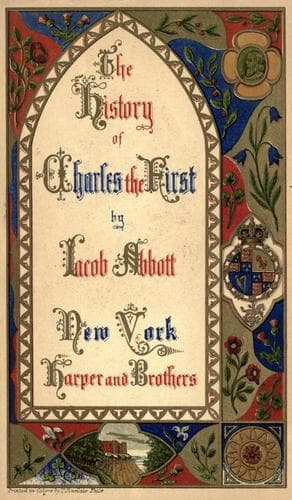
History of King Charles the First of EnglandAbbott, Jacob
History
History of King Charles the First of England
Abbott, Jacob
Charles I, King of England, 1600-1649; Great Britain -- History -- Charles I, 1625-1649; Great Britain -- Kings and rulers -- Biography
The Scotch, besides organizing a sort of civil government, took
measures for summoning a general assembly of their Church. This
assembly met at Glasgow. The nobility and gentry flocked to Glasgow
at the time of the meeting, to encourage and sustain the assembly,
and to manifest their interest in the proceedings. The assembly very
deliberately went to work, and, not content with taking a stand against
the Liturgy which Charles had imposed, they abolished the fabric of
Episcopacy--that is, the government of bishops--altogether. Thus Laud's
attempt to perfect and confirm the system resulted in expelling it
completely from the kingdom. It has never held up its head in Scotland
since. They established Presbyterianism in its place, which is a sort
of republican system, the pastors being all officially equal to each
other, though banded together under a common government administered by
themselves.
[Sidenote: 1639.]
[Sidenote: The king's expedition to the north.]
The king was determined to put down this rebellion at all hazards. He
had made such good use of the various irregular modes of raising money
which have been already described, and had been so economical in the
use of it, that he had now quite a sum of money in his treasury; and
had it not been for the attempt to enforce the unfortunate Liturgy
upon the people of Scotland, he might, perhaps, have gone on reigning
without a Parliament to the end of his days. He had now about two
hundred thousand pounds, by means of which, together with what he could
borrow, he hoped to make one single demonstration of force which would
bring the rebellion to an end. He raised an army and equipped a fleet.
He issued a proclamation summoning all the peers of the realm to attend
him. He moved with this great concourse from London toward the north,
the whole country looking on as spectators to behold the progress of
this great expedition, by which their monarch was going to attempt to
subdue again his _other_ kingdom.
[Sidenote: The army at York.]
[Sidenote: The oath.]
Public-domain text, read in full here on John Shaqi.
Reviews
Reviews
No reviews yet
Be the first to share your thoughts on this work.
Elsewhere in the archive
Join the Discussion
Join the discussion
Sign in to leave a comment or review.
Sign InorCreate an account