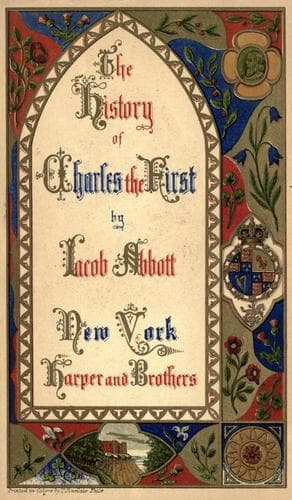
History of King Charles the First of EnglandAbbott, Jacob
History
History of King Charles the First of England
Abbott, Jacob
Charles I, King of England, 1600-1649; Great Britain -- History -- Charles I, 1625-1649; Great Britain -- Kings and rulers -- Biography
To return now to the troubles in Scotland. The king found that it
would be impossible to go on without supplies, and he accordingly
concluded, on the whole, to call a Parliament. He was in serious
trouble. Laud was in serious trouble too. He had been indefatigably
engaged for many years in establishing Episcopacy all over England, and
in putting down, by force of law, all disposition to dissent from it;
and in attempting to produce, throughout the realm, one uniform system
of Christian faith and worship. This was his idea of the perfection
of religious order and right. He used to make an annual visitation
to all the bishoprics in the realm; inquire into the usages which
prevailed there; put a stop, so far as he could, to all irregularities;
and confirm and establish, by the most decisive measures, the
Episcopal authority. He sent in his report to the king of the results
of his inquiries, asking the king's aid, where his own powers were
insufficient, for the more full accomplishment of his plans. But,
notwithstanding all this diligence and zeal, he found that he met with
very partial success. The irregularities, as he called them, which he
suppressed in one place, would break out in another; the disposition to
throw off the dominion of bishops was getting more and more extensive
and deeply seated; and now, the result of the religious revolution in
Scotland, and of the general excitement which it produced in England,
was to widen and extend this feeling more than ever.
[Sidenote: Defense of Episcopacy.]
[Sidenote: Progress of non-conformity.]
He did not, however, give up the contest. He employed an able writer
to draw up a defense of Episcopacy, as the true and scriptural form
of Church government. The book, when first prepared, was moderate in
its tone, and allowed that in some particular cases a Presbyterian
mode of government might be admissible; but Laud, in revising the
book, struck out these concessions as unnecessary and dangerous, and
placed Episcopacy in full and exclusive possession of the ground, as
the divinely instituted and only admissible form of Church government
and discipline. He caused this book to be circulated; but the attempt
to reason with the refractory, after having failed in the attempt to
coerce them, is not generally very successful. The archbishop, in his
report to the king this year of the state of things throughout his
province, represents the spirit of non-conformity to the Church of
England as getting too strong for him to control without more efficient
help from the civil power; but whether it would be wise, he added, to
undertake any more effectual coercion in the present distracted state
of the kingdom, he left it for the king to decide.
[Sidenote: A Parliament called.]
[Sidenote: Strafford appointed commander-in-chief.]
Public-domain text, read in full here on John Shaqi.
Reviews
Reviews
No reviews yet
Be the first to share your thoughts on this work.
Elsewhere in the archive
Join the Discussion
Join the discussion
Sign in to leave a comment or review.
Sign InorCreate an account