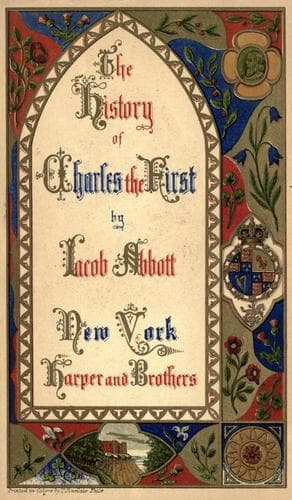
History of King Charles the First of EnglandAbbott, Jacob
History
History of King Charles the First of England
Abbott, Jacob
Charles I, King of England, 1600-1649; Great Britain -- History -- Charles I, 1625-1649; Great Britain -- Kings and rulers -- Biography
The trial lasted eighteen days, the excitement increasing constantly to
the end. There was nothing proved which could with any propriety be
considered as treason. He had managed the government, it is true, with
one set of views in respect to the absolute prerogatives and powers of
the king, while those who now were in possession of power held opposite
views, and they considered it a matter of necessity that he should
die. The charge of treason was a pretext to bring the case somewhat
within the reach of the formalities of law. It is one of the necessary
incidents of all governmental systems founded on force, and not on the
consent of the governed, that when great and fundamental questions
of policy arise, they often bring the country to a crisis in which
there can be no real settlement of the dispute without the absolute
destruction of one party or the other. It was so now, as the popular
leaders supposed. They had determined that stern necessity required
that Laud and Strafford must die; and the only object of going through
the formality of a trial was to soften the violence of the proceeding
a little, by doing all that could be done toward establishing a legal
justification of the deed.
[Sidenote: Vote on the bill of attainder.]
The trial, as has been said, lasted eighteen days. During all this
time, the leaders were not content with simply urging the proceedings
forward energetically in Westminster Hall. They were maneuvering
and managing in every possible way to secure the final vote. But,
notwithstanding this, Strafford's defense was so able, and the failure
to make out the charge of treason against him was so clear, that it
was doubtful what the result would be. Accordingly, without waiting
for the decision of the Peers on the impeachment, a bill of attainder
against the earl was brought forward in the House of Commons. This bill
of attainder was passed by a large majority--yeas 204, nays 59. It was
then sent to the House of Lords. The Lords were very unwilling to pass
it.
[Sidenote: Interposition of the king.]
While they were debating it, the king sent a message to them to say
that in his opinion the earl had not been guilty of treason, or of
any attempt to subvert the laws; and that several things which had
been alleged in the trial, and on which the bill of attainder chiefly
rested, were not true. He was willing, however, if it would satisfy
the enemies of the earl, to have him convicted of a misdemeanor, and
made incapable of holding any public office from that time; but he
protested against his being punished by a bill of attainder on a charge
of treason.
[Sidenote: Clamor of the populace.]
[Sidenote: Condemnation.]
Public-domain text, read in full here on John Shaqi.
Reviews
Reviews
No reviews yet
Be the first to share your thoughts on this work.
Elsewhere in the archive
Join the Discussion
Join the discussion
Sign in to leave a comment or review.
Sign InorCreate an account