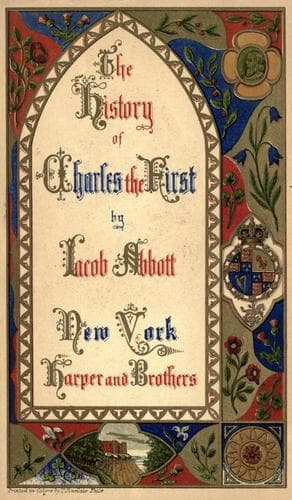
History of King Charles the First of EnglandAbbott, Jacob
History
History of King Charles the First of England
Abbott, Jacob
Charles I, King of England, 1600-1649; Great Britain -- History -- Charles I, 1625-1649; Great Britain -- Kings and rulers -- Biography
"To set your Majesty's conscience at Liberty, I do most humbly
beseech your Majesty for Prevention of Evils, which may happen by
your Refusal, to pass this Bill. Sir, My Consent shall more acquit
you herein to God, than all the World can do besides; To a willing
Man there is no Injury done; and as by God's Grace, I forgive all the
World, with a calmness and Meekness of infinite Contentment to my
dislodging Soul, so, Sir, to you I can give the Life of this World
with all the cheerfulness imaginable, in the just Acknowledgment of
your exceeding Favors; and only beg that in your Goodness you would
vouchsafe to cast your gracious Regard upon my poor Son and his three
sisters, less or more, and no otherwise than as their unfortunate
Father may hereafter appear more or less guilty of this Death. God
long preserve your Majesty."
[Sidenote: The king signs the bill.]
[Sidenote: Strafford's surprise.]
On receiving this letter the king caused the bill to be signed. He
would not do it with his own hands, but commissioned two of his council
to do it in his name. He then sent a messenger to Strafford to announce
the decision, and to inform him that he must prepare to die. The
messenger observed that the earl seemed surprised; and after hearing
that the king had signed the bill, he quoted, in a tone of despair, the
words of Scripture, "Put not your trust in princes, nor in the sons of
men, for in them is no salvation." Historians have thought it strange
that Strafford should have expressed this disappointment when he had
himself requested the king to resist the popular will no longer; and
they infer from it that he was not sincere in the request, but supposed
that the king would regard it as an act of nobleness and generosity on
his part, that would render him more unwilling than ever to consent to
his destruction, and that he was accordingly surprised and disappointed
when he found that the king had taken him at his word. It is said,
however, by some historians, that this letter was a forgery, and that
it was written by some of Strafford's enemies to lead the king to
resist no longer. The reader, by perusing the letter again, can perhaps
form some judgment whether such a document was more likely to have
been fabricated by enemies, or really written by the unhappy prisoner
himself.
[Sidenote: The king asks mercy for Strafford.]
[Sidenote: Mercy refused.]
The king did not entirely give up the hope of saving his friend, even
after the bill of attainder was signed. He addressed the following
message to the House of Lords.
Public-domain text, read in full here on John Shaqi.
Reviews
Reviews
No reviews yet
Be the first to share your thoughts on this work.
Elsewhere in the archive
Join the Discussion
Join the discussion
Sign in to leave a comment or review.
Sign InorCreate an account