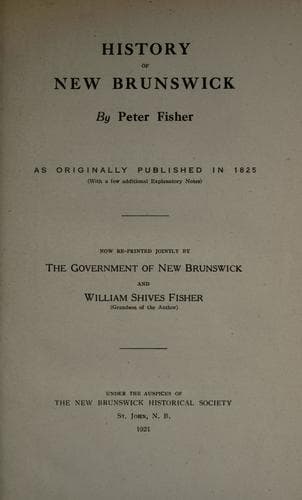
New Brunswick -- Description and travel; New Brunswick -- History
The exploring and surveying party then proceeded to view the lands
round the harbour and bay of Saint John in a whale boat, they brought
with them: for they could not travel on the land, on account of the
multitude of fallen trees that had been torn up by the roots in a
violent gale of wind, nearly four years previous. (The same gale
extended as far up the river as the Oromocto, and most of the Country
below that place, was equally incumbered with the fallen trees.)--After
making all the discoveries that could be made near the harbour, it was
the unanimous opinion that all the lands near that part of the Country,
were unfit for making any settlements at that time, and in about ten
days from their first arrival, they set out to view the country as far
as Saint Anns, ninety miles up the river, where they expected to find
an extensive body of clear land that had been formerly improved by the
French inhabitants. On their way to that place they landed wherever
they saw any appearance of improvement: all such small spots, as far up
as Milk Creek, were supposed not to exceed one hundred acres, most of
which had been very roughly cleared.--On the arrival of the exploring
party at Saint Anns, they lost no time in making a shelter for
themselves, nearly opposite the river Nashwouk, (as it was then
pronounced by the Indians,) but since, with some variation, as there is
in the original names of divers other rivers, lakes, and names by which
the tribes were distinguished,--and they commenced their survey at the
small gravelly point against Government-House, with an intention to
survey a Township, to terminate twelve miles below that place, and
after surveying the courses of the river about four miles downward, a
large company of Indians came down about nine miles from their Priest's
residence, with his Interpreter: all having painted faces of divers
colours and figures, and dressed in their war habits. The chiefs, with
grave countenances, informed the adventurers that they were trespassers
on their rights: that the Country belonged to them, and unless they
retired immediately, they, (the Indians), would compel them. This gave
no small alarm to a few men in the heart of an Indian Country, most of
whom had never beheld a wild Indian, but had all their lives heard of
their savage cruelties and murders. The reply made to the Chiefs was to
this effect; that the adventurers had received authority from the
Governor of Halifax to survey and settle any land they should chuse, at
the river Saint John--that they had never been informed of the Indians
claiming the village of Saint Anns; but as they then declared the land
there, to be their property, though it had been inhabited by the French
who were considered entitled to it, till its capture by the English,
they would retire further down the river.--In answer to this the Chiefs
suggested that the whole country belonged to the Indians, they had some
time ago, had a conference with Governor LAWRENCE, and had consented
Public-domain text, read in full here on John Shaqi.
Reviews
Reviews
No reviews yet
Be the first to share your thoughts on this work.
Elsewhere in the archive
Join the Discussion
Join the discussion
Sign in to leave a comment or review.
Sign InorCreate an account