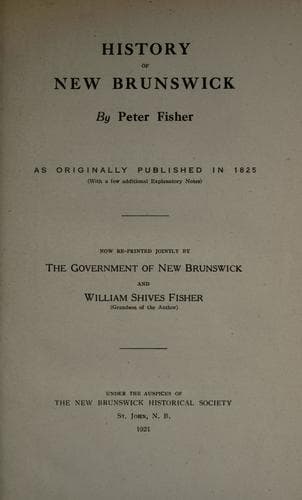
New Brunswick -- Description and travel; New Brunswick -- History
The season was wet and cold, and we were much discouraged at the
gloomy prospect before us. Those who had arrived a little earlier
had made better preparations for the winter; some had built small
log huts. This we could not do because of the lateness of our
arrival. Snow fell on the 2nd day of November to the depth of six
inches. We pitched our tents in the shelter of the woods and tried
to cover them with spruce boughs. We used stones for fireplaces.
Our tent had no floor but the ground. The winter was very cold,
with deep snow, which we tried to keep from drifting in by putting
a large rug at the door. The snow, which lay six feet around us,
helped greatly in keeping out the cold. How we lived through that
awful winter I hardly know. There were mothers, that had been
reared in a pleasant country enjoying all the comforts of life,
with helpless children in their arms. They clasped their infants to
their bosoms and tried by the warmth of their own bodies to protect
them from the bitter cold. Sometimes a part of the family had to
remain up during the night to keep the fires burning, so as to keep
the rest from freezing. Some destitute people made use of boards,
which the older ones kept heating before the fire and applied by
turns to the smaller children to keep them warm.
Many women and children, and some of the men, died from cold and
exposure. Graves were dug with axes and shovels near the spot where
our party had landed, and there in stormy winter weather our loved
ones were buried. We had no minister, so we had to bury them
without any religious service, besides our own prayers. The first
burial ground continued to be used for some years until it was
nearly filled. We called it "The Loyalist Provincials Burial
Ground."
The site of this old grave-yard, is on the Ketchum place at Salamanca,
just below Fredericton, near the shore. Some rude headstones may
perhaps yet be found there. The late Adolphus G. Beckwith told me that
he remembered when a boy to have seen a number of pine "head-boards,"
much decayed, but still standing in this old cemetery. The painted
epitaphs, or inscriptions, were in some cases fairly well preserved. He
remembered, he said, that many of the names seemed to be German (or
Dutch), a statement which I hardly credited at the time, but which is
entirely in harmony with the old grandmother's story. Continuing her
narrative, she says:
Among those who came with us to St. Ann's, or who were there when
we arrived were Messrs. Swim, Burkstaff, McComesky, three named
Ridner, Wooley, Bass, Paine, Ryerse, Acker, Lownsberry, Ingraham,
Buchanan, Ackerman, Donley, Vanderbeck, Smith, Essington and some
few others.
Public-domain text, read in full here on John Shaqi.
Reviews
Reviews
No reviews yet
Be the first to share your thoughts on this work.
Elsewhere in the archive
Join the Discussion
Join the discussion
Sign in to leave a comment or review.
Sign InorCreate an account