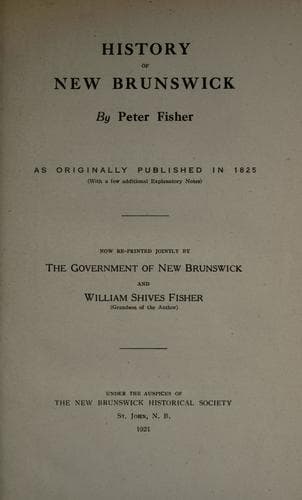
New Brunswick -- Description and travel; New Brunswick -- History
As soon as the snow was off the ground we began to build log
houses, but were obliged to desist for want of food. Your
grandfather went up the river to Captain McKay's for provisions,
and found no one at home but an old colored slave woman, who said
her master and his man had gone out to see if they could obtain
some potatoes or meal, having in the house only half a box of
biscuits. Some of the people at St. Ann's, who had planted a few
potatoes, were obliged to dig them up and eat them.
Again a few comments will show the reliability of the old lady's
narrative. The three houses she mentions on the site of Fredericton
were those of Benjamin Atherton, built about 1767 at the upper end of
the town, near the site of the old Government House; Philip Weade's,
which stood on the river bank in front of the Cathedral, and Olivier
Thibodeau's, an Acadian, whose log house was at the lower end of town.
The tradition regarding the massacre of some of the first settlers at
St. Ann's refers doubtless to the destruction of the French settlement
there by McCurdy's New England Rangers in February, 1759, as is
described at page 242 in Dr. Raymond's "St. John River History." The
party of Loyalists, who had gone further up the river in the late
Spring of 1783, were the King's American Dragoons, who settled in
Prince William. Resuming once more the narrative, the grandmother says:
In our distress we were gladdened by the discovery of some large
patches of pure white beans, marked with a black cross. They had
probably been originally planted by the French, but were, now
growing wild. In our joy at the discovery we called them at first
the "Royal Provincials' bread," but afterwards "The staff of life
and hope of the starving." I planted some of these beans with my
own hands, and the seed was preserved in our family for many years.
There was great rejoicing when the first schooner arrived with
corn-meal and rye. In those days the best passages up and down the
river took from three to five days. Sometimes the schooners were a
week or ten days on the way. It was not during the first year alone
that we suffered from want of food, other years were nearly as bad.
The first summer after our arrival all hands united in building
their log houses. Dr. Earle's was the first that was finished. Our
people had but few tools and those of the rudest sort. They had
neither bricks or lime, and chimneys and fireplaces were built of
stone laid in yellow clay. They covered the roofs of the houses
with bark bound over with small poles. The windows had only four
small panes of glass.
Public-domain text, read in full here on John Shaqi.
Reviews
Reviews
No reviews yet
Be the first to share your thoughts on this work.
Elsewhere in the archive
Join the Discussion
Join the discussion
Sign in to leave a comment or review.
Sign InorCreate an account