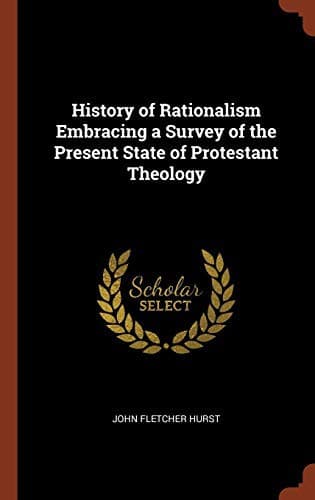
History of Rationalism Embracing a Survey of the Present State of Protestant TheologyHurst, J. F. (John Fletcher)
History
History of Rationalism Embracing a Survey of the Present State of Protestant Theology
Hurst, J. F. (John Fletcher)
Protestantism; Rationalism -- History
He labored as an educator, preacher, professor, and author. He made all
his enterprises subservient to the dearest object of his life,--money.
He wrote plain books for the masses, and his writings were perused
alike in palace and cottage. While a resident in Halle he established an
inn in the suburbs of the city where his depraved nature was permitted
to indulge in those nameless liberties unbecoming, not only the
theologian, but the rational man. His _liaison_ with the servant-girl in
his employ made his wife an object of public pity, and we can easily
understand his injustice to the latter when he tells us himself that he
had never loved with passion. His death was of a piece with his life.
Having been a public frequenter of brothels and the associate of the
loosest company, he died like the libertine. He was taken off by
syphilis.
It is not necessary to enlarge upon the lesson of Bahrdt's life. He was
the German crystallization of all the worst elements of French
skepticism. He began his work with an evil purpose, and never sought the
wisdom of God who promises to give liberally to all who ask him. The
infamy of his life was soon forgotten, and only his teachings remained
to corrupt the young and injure the mature of the land. While his love
of money controlled his matrimonial alliances and literary labors, his
hatred of revealed religion distorted his whole moral and intellectual
nature. He is illustrative of the certain doom which awaits the man who
commits himself to the sole guidance of his doubts. Semler's moral life
was _in spite_ of erroneous opinions; Bahrdt's was in _conformity_ with
them. And what the latter was in his career and death is the best
comment that can be written on the natural effect of Rationalism. Would
that he had been the only warning; but he had his followers when his
creed became the fashion of the German church. The depth of his infamy
is only aggravated by the holy sphere in which he wrought fearful havoc
upon the succeeding generation. The Old Play says truly:
"That sin does ten times aggravate itself,
That is committed in an holy place;
An evil deed done by authority
Is sin and subornation; deck an ape
In tissue, and the beauty of the robe
Adds but the greater scorn unto the beast;
The poison shows worst in a golden cup;
Dark night seems darker by the lightning's flash;
Lilies that fester smell far worse than weeds;
And every glory that inclines to sin,
The shame is trebled by the opposite."
CHAPTER VI.
CONTRIBUTIONS OF LITERATURE AND PHILOSOPHY.
Public-domain text, read in full here on John Shaqi.
Reviews
Reviews
No reviews yet
Be the first to share your thoughts on this work.
Elsewhere in the archive
Join the Discussion
Join the discussion
Sign in to leave a comment or review.
Sign InorCreate an account