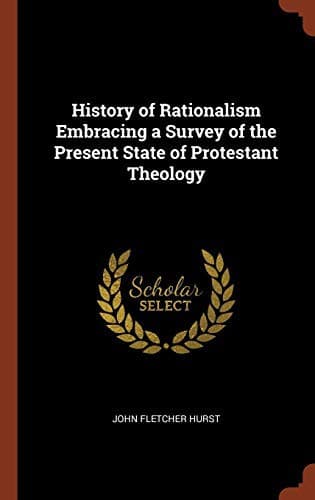
History of Rationalism Embracing a Survey of the Present State of Protestant TheologyHurst, J. F. (John Fletcher)
History
History of Rationalism Embracing a Survey of the Present State of Protestant Theology
Hurst, J. F. (John Fletcher)
Protestantism; Rationalism -- History
But it soon became very evident that the Rationalists and
Supernaturalists were unable to harmonize. The points of difference were
so decided that it was vain to expect a union. Reinhard was correct in
his opinion that one or the other would have to yield. Just at the
crisis when these two systems were attracting greatest attention,
Schleiermacher published his _System of Doctrines_, 1821. In this work
he proved what had not been conceived by any writer save himself, that
there was another road to progress. As soon as it gained a hearing the
disputants saw that their arguments were no longer of value, that the
ground of the discussion was altogether changed, and that the cause of
faith must eventually triumph. The book was a complete surprise to all
parties. It was a stroke of genius, destined alike to recast existing
theology and to create a new public sentiment for the future.
The leading ideas developed in this master-piece of theology are Christ,
Religion, and the Church. The Rationalists had ever held that reason is
the criterion of truth, but Schleiermacher elevates Christian
consciousness to the throne. They had reduced religion to a mere formal
morality; yet he shows that religion and morality are very different,
and that the former consists neither in knowledge or action, but in the
sentiment or feeling of the heart. Thus he develops the opinion first
published in the _Discourses on Religion_. He uses the term "piety" to
designate religion. This piety should become the great spring of our
life and the inspiring power of faith. There is no real inconsistency
between knowledge and piety; they can harmonize beautifully when carried
to their loftiest extent. The religious feeling, which judges truth, is
characterized by absolute dependence. This is not degrading to man, but
his true dignity consists in it. We have different conceptions of God,
derived from the feeling of dependence, which is varied according to the
nature of outward circumstances. Christ must be judged by us not so much
according to the received accounts of his life as by his great relations
to us as Redeemer and Saviour. Our view of him must be deeper than his
mere incarnation. He was concerned in creation just so far as it was not
completed until redeemed. If we would have communion with God we can
enjoy it only through the medium of Christ. The peculiar value of
redemption lies in its applicability to our necessity for salvation. The
very sinlessness of Christ can be in a measure incorporated with our
humanity, and we should aim after the mind that was in Christ. We are
never fully united with Christ until we have a perfect spirit of
dependence. When this occurs, the soul is passing into the glorious
condition of the new birth. The church is the depository of that spirit
of Christ which every believer must enjoy in order to inherit eternal
life. The church, however, is not self-existent. Like the heavenly
Public-domain text, read in full here on John Shaqi.
Reviews
Reviews
No reviews yet
Be the first to share your thoughts on this work.
Elsewhere in the archive
Join the Discussion
Join the discussion
Sign in to leave a comment or review.
Sign InorCreate an account