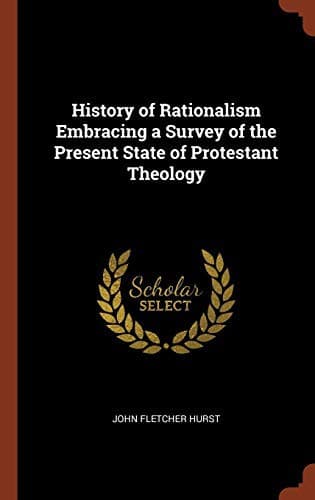
History of Rationalism Embracing a Survey of the Present State of Protestant TheologyHurst, J. F. (John Fletcher)
History
History of Rationalism Embracing a Survey of the Present State of Protestant Theology
Hurst, J. F. (John Fletcher)
Protestantism; Rationalism -- History
Rothe regards the supernatural interference of the Deity in the stream
of human history as a part of that history. It is not enough that the
divine interposition has incorporated itself with the traditions of the
race; it must be fixed in a written narrative. Not only must there be a
book or writing, but that book must be of a historical character. As the
revelation did not consist in doctrines, so the doctrine we require is
not a creed or compend of doctrines. Besides vouching the facts, the
doctrines must represent them in a vivid manner; that is, the writing
must be such as can stand for long posterior generations in the place of
the original revelation, and place us in the immediate personal
experience of revelation. It is part of the extraordinary operation of
the Deity to provide such a writing. The document itself, as well as the
facts it relates, are supernaturally produced. What the divine
influences in the world are to its moral and human laws, the record of
those influences is to ordinary narrative. The Bible is therefore what
the old Protestant theology styled it, "The Word of God": but in a very
different sense. It was meant by that phrase that the books, as we have
them, were dictated by God in such a way that the sacred penmen
contributed nothing but the letter-marks upon the paper. The dogma of
inspiration current in the sixteenth century is not accepted. The
inspiration which Rothe attributes to the Bible is the same by which he
explains that peculiar impression received by the pious soul from its
study of the book. It is the constant experience of the evangelical
Christian, that, in his Bible, he possesses a direct means of grace.
Scripture is to him an active medium of the saving work of God in his
soul, and supernatural forces move within it. The Bible stands alone in
all literature as this incarnation of a fresh, full, life-giving
religious spirit. But the peculiar influence which it exercises upon
minds indicates not merely a divine element in its pages, but a whole,
complex, and sound human spirit side by side with that divine element;
the two not crossing or interfering with each other, but forming
together a unity of living truth. The books of the Bible must be
regarded as the general product of the minds of their human authors.
These authors have had their moments of inspiration, to which they owe
much of the religious experience they have embalmed in their writings.
But inspiration was not the normal condition of their minds, nor were
their books written during the moments of such inspiration. Again, not
every part of the Bible is an equally full and intense expression of
this spiritual mind of the writer. We must assume degrees of inspiration
according with the nature of the contents, and with their nearer or
remoter bearing on the proper matter of the prophetical utterances.[78]
Public-domain text, read in full here on John Shaqi.
Reviews
Reviews
No reviews yet
Be the first to share your thoughts on this work.
Elsewhere in the archive
Join the Discussion
Join the discussion
Sign in to leave a comment or review.
Sign InorCreate an account