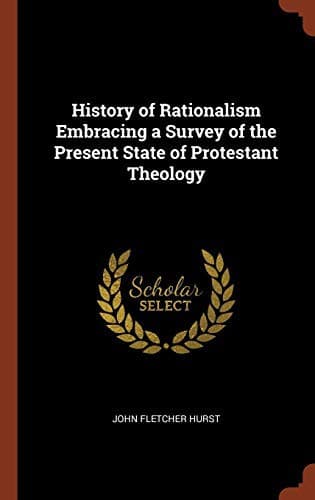
History of Rationalism Embracing a Survey of the Present State of Protestant TheologyHurst, J. F. (John Fletcher)
History
History of Rationalism Embracing a Survey of the Present State of Protestant Theology
Hurst, J. F. (John Fletcher)
Protestantism; Rationalism -- History
There was one point of agreement between Cocceius and Des Cartes: their
common aim of emancipation from Scholasticism. But the former strove by
revelation, the latter by philosophy to secure the result. It has been
charged that Des Cartes influenced Cocceius, since the school of that
philosopher was growing into power at the very period of the Cocceian
tendencies. But the charge is groundless. Des Cartes stood on the ground
of reason alone, while Cocceius planted himself upon the Scriptures.
Thus there was a world-wide difference between the two men at the very
starting-point of their systems; a difference which becomes more
apparent at every additional step in the study of their sentiments.
If Cocceius was opposed when he arrayed the Bible against Scholasticism,
Descartes might be expected to meet with increased resistance when he
used only the weapon of philosophy. "Aristotle," said the theological
world of Holland, "was a heathen, it is true, but then he afterwards
became soundly converted to Catholicism. In due time he was transformed
into a most exemplary Protestant. Yet this Des Cartes is a downright
Jesuit, and a very demon let loose from the infernal world. His whole
system commences with doubt and is pervaded by it. How dangerous then to
our orthodoxy is the attack of this Catholic Arminian! If his assumption
concerning skepticism be correct our whole theology becomes overturned;
for then the elect would have ground for doubting their own salvation,
which would be opposed to the infallible doctrine of the final
perseverance of the saints. And to crown the scene of this Des Cartes'
audacity, he holds that the earth and not the sun turns round, which, as
good father Brakel says, 'is a sure sign that the man's head is
turned.'"
Voetius was the leader of the forces against the pretentious philosophy.
A book, issued anonymously by a friend of Spinoza, applying a little
more logic to the Cartesian idea of substance, caused him to obtain
additional ground. For the new school which he was combating already
rested under the imputation of Crypto-Atheism. The hand of the
government interfered, and Cartesianism appeared to be extinguished. But
it had its secret admirers, especially in the academies of Northern
France, where its adherents occupied almost every chair of instruction.
Its last representative was Ruard Andala, 1701, at whose death Newton
and Leibnitz came into power.
Public-domain text, read in full here on John Shaqi.
Reviews
Reviews
No reviews yet
Be the first to share your thoughts on this work.
Elsewhere in the archive
Join the Discussion
Join the discussion
Sign in to leave a comment or review.
Sign InorCreate an account