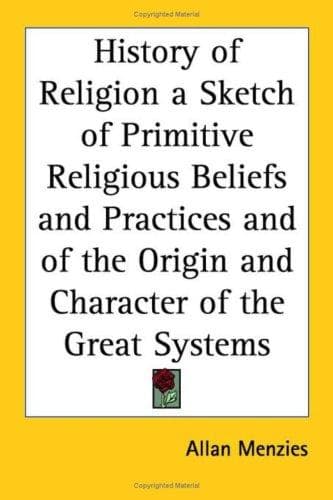
History of Religion: A Sketch of Primitive Religious Beliefs and Practices, and of the Origin and Character of the Great SystemsMenzies, Allan
Religion
History of Religion: A Sketch of Primitive Religious Beliefs and Practices, and of the Origin and Character of the Great Systems
Menzies, Allan
Religions
to their works. Among the national delinquencies the disorganisation
and apparent wilfulness shown in worship have a prominent place.
Worship is not what the service of Jehovah ought to be. Other beings
than he are sought after; heathenish festivals are kept, the indecent
practices of heathen worship are introduced into that of Jehovah:
there is no seriousness, no dignity, no worthy order, in the acts of
worship that are done. Any place does for them, and many of the
places used are quite unfit, from their associations, for the service
of Jehovah. They are celebrated more as wild orgies than as solemn
approaches to the deity.
The interests of the prophets, however, do not centre in ritual. The
worship of other gods than Jehovah, or the service of Jehovah in
unfitting ways, they could not but denounce, but they have no
positive instructions to give about worship. When the people have
apparently given up the wrong worships, and are applying themselves
with zeal to that of Jehovah, seeking his favour by austerities, or
by costly offerings, the prophets are no less severe on this line of
conduct. Every one is familiar with the passages in which they
apparently denounce sacrifice altogether as a thing God has never
asked, and by which Israel cannot hope to win his favour. These
passages do not prove that the prophets desired the entire
discontinuance of sacrifice; they merely compare sacrifice with
another line of duty which is said to be vastly more important. Not
sacrifice but mercy, not sacrifice but to do justly, and love mercy,
and walk humbly with God,--is the burden of these utterances. Even
more than by the irregularities of worship, the prophets are shocked
by the more directly moral shortcomings of their people. The people
are accused of all the acts that are forbidden in the decalogue of
Exodus xx., and of many offences not there named. Especially are the
prophets indignant at the hardheartedness of the rich towards the
poor, and at the frequent disregard of faith and truth; oppression
and bribery, gluttony and other luxurious excesses, are frequently
their mark. These most of all are the sins which have called down the
divine judgments; these are the transgressions which make it
impossible for Jehovah to turn away the punishment of Israel and of
Judah. He is, above all things, a righteous god, who loves judgment
and mercy, and a people which so manifestly fails to practice justice
and mercy cannot continue to be his people; he must destroy them.
Public-domain text, read in full here on John Shaqi.
Reviews
Reviews
No reviews yet
Be the first to share your thoughts on this work.
Elsewhere in the archive
Join the Discussion
Join the discussion
Sign in to leave a comment or review.
Sign InorCreate an account