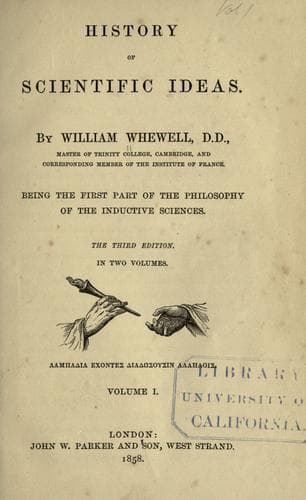
This early assertion of principles which now appear neither
obvious nor self-evident, is not to be considered as a
groundless assumption on the part of the discoverers by whom
it was made. On the contrary, it is evidence of the deep
sagacity and clear thought which were {259} requisite in
order to make such discoveries. For these results are really
rigorous consequences of the laws of motion in their
simplest form: and the evidence of them was probably
present, though undeveloped, in the minds of the
discoverers. We are told of geometrical students, who, by a
peculiar aptitude of mind, perceived the evidence of some of
the more advanced propositions of geometry without going
through the introductory steps. We must suppose a similar
aptitude for mechanical reasonings, which, existing in the
minds of Stevinus, Galileo, Newton, and Huyghens, led them
to make those assumptions which finally resolved themselves
into the laws of motion.
We may observe further, that the simplicity and evidence
which the laws of mechanics have at length assumed, are much
favoured by the usage of words among the best writers on
such subjects. Terms which originally, and before the laws
of motion were fully known, were used in a very vague and
fluctuating sense, were afterwards limited and rendered
precise, so that assertions which at first appear identical
propositions become distinct and important principles. Thus
_force_, _motion_, _momentum_, are terms which were
employed, though in a loose manner, from the very outset of
mechanical speculation. And so long as these words retained
the vagueness of common language, it would have been a
useless and barren truism to say that 'the momentum is
proportional to the force,' or that 'a body loses as much
motion as it communicates to another.' But when 'momentum'
and 'quantity of motion' are defined to mean the product of
mass and velocity, these two propositions immediately become
distinct statements of the third law of motion and its
consequences. In like manner, the assertion that 'gravity is
a uniform force' was assented to, before it was settled what
a uniform force was; but this assertion only became
significant and useful when that point had been properly
determined. The statement that 'when different motions are
communicated to the same body their effects are {260}
compounded,' becomes the second law of motion, when we
define what composition of motions is. And the same process
may be observed in other cases.
And thus we see how well the form which science ultimately
assumes is adapted to simplify knowledge. The definitions
which are adopted, and the terms which become current in
precise senses, produce a complete harmony between the
matter and the form of our knowledge; so that truths which
were at first unexpected and recondite, became familiar
phrases, and after a few generations sound, even to common
ears, like identical propositions.
Public-domain text, read in full here on John Shaqi.
Reviews
Reviews
No reviews yet
Be the first to share your thoughts on this work.
Elsewhere in the archive
Join the Discussion
Join the discussion
Sign in to leave a comment or review.
Sign InorCreate an account