Yet, as we have just seen in the history of the laws of
motion, we may go on collecting our knowledge from
observation, and enlarging and simplifying it, till it
approaches or attains to complete universality and seeming
necessity. Whether the laws of motion, as we now know them,
can be rigorously traced to an absolute necessity in the
nature of things, we have not ventured absolutely to
pronounce. But we have seen that some of the most acute and
profound mathematicians have believed that, for these laws
of motion, or some of them, there was such a demonstrable
necessity compelling them to be such as they are, and no
other. Most of those who have carefully studied the
principles of Mechanics will allow that some at least of the
primary laws of motion approach very near to this character
of necessary truth; and will confess that it would be
difficult to imagine any other consistent {264} scheme of
fundamental principles. And almost all mathematicians will
allow to these laws an absolute universality; so that we may
apply them without scruple or misgiving, in cases the most
remote from those to which our experience has extended. What
astronomer would fear to refer to the known laws of motion,
in reasoning concerning the double stars; although these
objects are at an immeasurably remote distance from that
solar system which has been the only field of our
observation of mechanical facts? What philosopher, in
speculating respecting a magnetic fluid, or a luminiferous
ether, would hesitate to apply to it the mechanical
principles which are applicable to fluids of known
mechanical properties? When we assert that the quantity of
motion in the world cannot be increased or diminished by the
mutual actions of bodies, does not every mathematician feel
convinced that it would be an unphilosophical restriction to
limit this proposition to such modes of action as we have tried?
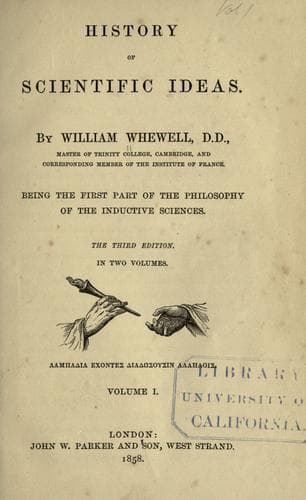
Yet no one can doubt that, in historical fact, these laws
were collected from experience. That such is the case, is no
matter of conjecture. We know the time, the persons, the
circumstances, belonging to each step of each discovery. I
have, in the History, given an account of these discoveries;
and in the previous chapters of the present work, I have
further examined the nature and the import of the principles
which were thus brought to light.
Public-domain text, read in full here on John Shaqi.
Reviews
Reviews
No reviews yet
Be the first to share your thoughts on this work.
Elsewhere in the archive
Join the Discussion
Join the discussion
Sign in to leave a comment or review.
Sign InorCreate an account