This Fifth Book, on the subject of Polarities, is a short
one compared with most of the others. This arises in a great
measure from the circumstance that the Idea of Polarity has
only recently been apprehended and applied, with any great
degree of clearness, among physical philosophers; and is
even yet probably entertained in an obscure and ambiguous
manner by most experimental inquirers. I have been desirous
of not attempting to bring forward any doctrines upon the
subject, except such as have been fully illustrated and
exemplified by the acknowledged progress of the physical
sciences. If I had been willing to discuss the various
speculations which have been published respecting the
universal prevalence of Polarities in the universe, and
their results in every province of nature, I might easily
have presented this subject in a more extended form; but
this would not have been consistent with my plan of tracing
the influence of scientific Ideas only so far as they have
really aided in disclosing and developing scientific truths.
And as the influence of this Idea is clearly distinguishable
both from those which precede and those which follow, in the
character of the sciences to which it gives rise, and as it
appears likely to be hereafter of great extent and
consequence, it seemed better to treat of it in a separate
Book, although of a brevity disproportioned to the rest.
END OF VOL. I.
Cambridge: Printed at the University Press.
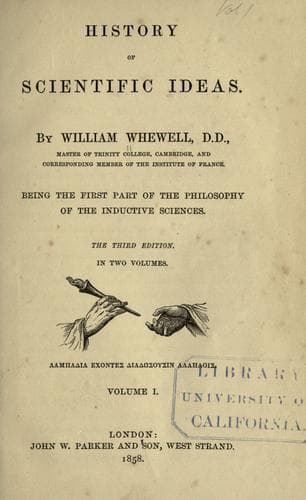
HISTORY
OF
SCIENTIFIC IDEAS.
VOLUME II.
Cambridge;
PRINTED BY C. J. CLAY, M.A.
AT THE UNIVERSITY PRESS.
HISTORY
OF
SCIENTIFIC IDEAS.
BY WILLIAM WHEWELL, D.D.,
MASTER OF TRINITY COLLEGE, CAMBRIDGE, AND
CORRESPONDING MEMBER OF THE INSTITUTE OF FRANCE.
BEING THE FIRST PART OF THE PHILOSOPHY
OF THE INDUCTIVE SCIENCES.
_THE THIRD EDITION._
IN TWO VOLUMES.
ΛΑΜΠΑΔIΑ ΕΧΟΝΤΕΣ ΔIΑΔΩΣΟΥΣIΝ ΑΛΛΗΛΟIΣ
VOLUME II.
LONDON:
JOHN W. PARKER AND SON, WEST STRAND.
1858.
CONTENTS
OF
THE SECOND VOLUME.
BOOK VI.
THE PHILOSOPHY OF CHEMISTRY.
PAGE
CHAP. I. ATTEMPTS TO CONCEIVE ELEMENTARY COMPOSITION 3
_Art._ 1. Fundamental Ideas of Chemistry.
2. Elements.
3. Do Compounds resemble their Elements?
4. The Three Principles.
5. A Modern Errour.
6. Are Compounds determined by the Figure of Elements?
7. Crystalline Form depends on Figure of Elements.
8. Are Compounds determined by Mechanical Attraction
of Elements?
9. Newton's followers.
10. Imperfection of their Hypotheses.
CHAP. II. ESTABLISHMENT AND DEVELOPMENT OF THE IDEA OF
CHEMICAL AFFINITY 15
Public-domain text, read in full here on John Shaqi.
Reviews
Reviews
No reviews yet
Be the first to share your thoughts on this work.
Elsewhere in the archive
Join the Discussion
Join the discussion
Sign in to leave a comment or review.
Sign InorCreate an account