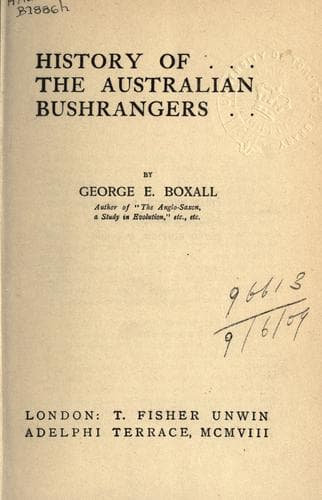
History of the Australian Bushrangers — John Shaqi
History of the Australian BushrangersBoxall, George
History
History of the Australian Bushrangers
Boxall, George
Bushrangers -- Australia
Norfolk Island, lying some seven hundred miles from the coast of New
South Wales, was first utilised as a penal settlement in 1788, when
it was decided that convicts who committed crimes in New South Wales
should be transported there for more severe treatment. Early in the
nineteenth century a rumour spread in Australia that Napoleon the First
intended to fit out a fleet to search for Admiral La Perouse, and to
found colonies in the south seas. The truth of this rumour seemed to
be affirmed by the activity of the naval authorities in New South
Wales. Settlements were made at Port Essington in the north, King
George's Sound in the west, and the Derwent River in Van Diemen's Land.
Shortly afterwards, in 1805, the prisoners were removed from Norfolk
Island to Hobart Town, apparently for the purpose of strengthening
the settlement in Van Diemen's Land. When Van Diemen's Land was made
independent of New South Wales, in 1825, Norfolk Island was again made
a penal settlement of the mother colony, and it so continued until
transportation to New South Wales ceased in 1842, when Norfolk Island
was transferred from the jurisdiction of the Governor of New South
Wales to that of the Governor of Van Diemen's Land. The treatment of
the prisoners in the island was rigorous in the extreme, and may aptly
be described as savage. When the enquiry of the House of Commons, by
Select Committee, was made in 1837 and 1838, as to the condition of
the convicts in the penal settlements, the few particulars published
about the evidence in the English newspapers had some effect on public
opinion, and in 1841, Captain Maconochie, one of the witnesses examined
who said that the prisoners might be governed with less harshness, was
appointed Commandant of Norfolk Island, with instructions to try the
mild reformatory treatment he advocated. Captain Maconochie and his
supporters in England do not seem to have realised that human beings
who have been under demoralising influences until they have reached
the adult age, and their characters have become set, are not amenable
to civilising influences. These should have been applied during the
impressionable years, and the younger they are applied the more
successful they are likely to be. This fact, however, does not yet seem
to be known sufficiently in England, and therefore small blame attaches
to Captain Maconochie, if he was not aware of it sixty years ago. The
new Commandant abolished Sunday labour as a punishment, shortened the
hours of labour on week-days, and granted holidays for good behaviour.
He allowed the men to build huts and to cultivate small patches of
ground, and thus to provide themselves with vegetables. He also gave
them tins to cook in, and served out rations individually, instead of
giving the rations out in messes. It does not appear that the prisoners
became unduly riotous under this treatment, and no such murders as
were mentioned by Judge Forbes and other witnesses before the Select
Public-domain text, read in full here on John Shaqi.
Reviews
Reviews
No reviews yet
Be the first to share your thoughts on this work.
Elsewhere in the archive
Join the Discussion
Join the discussion
Sign in to leave a comment or review.
Sign InorCreate an account