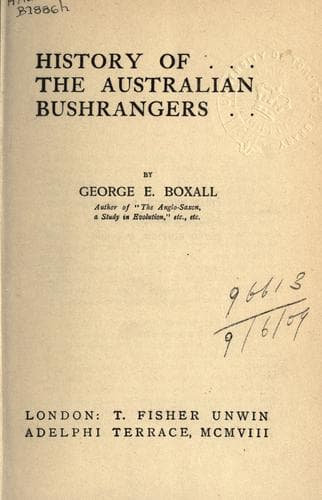
History of the Australian BushrangersBoxall, George
History
History of the Australian Bushrangers
Boxall, George
Bushrangers -- Australia
Sufficient has, I think, been said to indicate the state of the
country and the character of the crimes committed during this epoch.
How many men were shot while prowling about the tents on Ballarat,
Bendigo, Mount Alexander, and other diggings it is impossible to say.
Many of the bushrangers, after having made a haul on the roads or on
the diggings, went to Melbourne or Geelong and spent their ill-gotten
gains in riot and debauchery, and then committed crimes in these towns
for which they were captured and punished. Others returned to New
South Wales or to Van Diemen's Land and ended their careers there.
It was rarely known how many crimes even those who were captured had
committed. They were placed on trial for their last offence. In some
cases it was said that the prisoner had been guilty of other crimes,
but the difficulty of finding witnesses in a population which was
continuously shifting from one end of the country to the other, as new
goldfields were opened, made it impossible to prosecute for crimes
committed a few months before. It was the custom therefore to inflict
long terms of imprisonment to keep the evil-disposed out of mischief
for a time. When a prisoner was tried and convicted for more than one
crime the sentences were usually made concurrent, so that there was no
encouragement for the police to pile up a record of crimes against a
prisoner. Captain Melville was the one exception to this rule.
The sole motive for the robberies of this epoch was a sordid lust
for gold, which seems to have seized many men who but for the gold
discoveries might have lived out honourable lives. The case of George
Hanslip may be cited as an instance of this. He was a confidential
clerk employed by Mr. Spence, draper, of Collins Street, Melbourne.
He was sent by his employer to pay some accounts and purchase goods
in Sydney, at that time the emporium of Australia. For convenience of
carriage, in days when communication was difficult and bank drafts
rare, he was entrusted with 1400 ounces of gold and some jewellery,
and was instructed to offer the gold to Messrs. C. Newton & Co., of
Pitt Street, on his arrival at Sydney. He reached Sydney by boat at
nine a.m., but did not call at Messrs. Newton's store until three
p.m., when he reported that he had been robbed of the gold. He seemed
very excited, saying to Mr. Newton "Oh, what shall I do?" He asked
Mr. Newton to go with him to Malcolm's Adelphi Hotel, and Mr. McKeon,
one of the partners in the firm, did so, and saw a carpet bag which
had been ripped open. Hanslip said he felt certain that the gold had
been taken to Hobart Town, and asked Mr. Newton for the loan of £50
to enable him to go there to seek for it, but whether Hanslip overdid
his part or not, Mr. Newton began to be suspicious of him, and refused
to lend the money. One thing that tended to make him doubt that the
money had been stolen as Hanslip said, was that Hanslip was spending
money very freely.
Public-domain text, read in full here on John Shaqi.
Reviews
Reviews
No reviews yet
Be the first to share your thoughts on this work.
Elsewhere in the archive
Join the Discussion
Join the discussion
Sign in to leave a comment or review.
Sign InorCreate an account