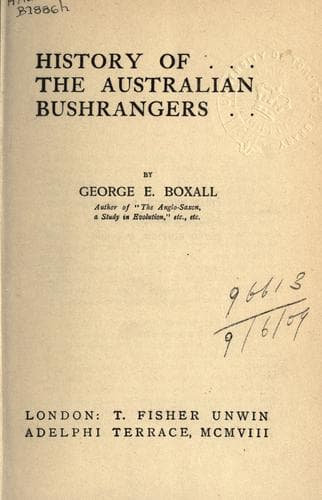
History of the Australian BushrangersBoxall, George
History
History of the Australian Bushrangers
Boxall, George
Bushrangers -- Australia
In such a neighbourhood it was impossible for any stranger to travel
with horses with any degree of safety. Horses bred in the district
could be duffed like sheep or cattle, and horses travelling through
could be "planted." If a man, who knew anything of the characteristics
of the settlers in this district, camped for the night there, and
failed to find his horses next morning, he did not waste time in
looking for them himself. He realised at once that one of "the boys"
had driven them off into some inaccessible ravine in the ranges, and
"planted" or hidden them there until a reward should be offered for
their recovery. He would therefore go to the nearest station and
enquire whether his horses had been seen. The answer would be "No."
Then the traveller would say that he was willing to pay "a note"
for their recovery. The reply of the native would probably be that
horses always went astray about there. There was such a get-away for
them, and the warrigals came down and enticed them off. The story of
the warrigals, or wild horses, tempting working horses away was a
common fiction. Hobbled horses could not keep up with the warrigals
across the ridges. But it was sufficiently plausible to serve. If the
working horses broke their hobbles they might perhaps go with the wild
horses, but even then it is uncertain. However, after a few minutes'
conversation, the native would probably say that if any one could
find the horses it was "Jack the Kid," or some other local character,
as he knew every gully in the ridges. The wideawake traveller could
understand that "Jack the Kid" was the man who had planted his horses,
and would not return them for less than "a note," that is £1, and on
this reward for villainy being promised the traveller might go to
his camp with the certainty that the horses would be brought to him
in about an hour. It would be useless to look for them, because the
planter would be on the watch, and if the owner was seen approaching
the gully where they were the horses would be driven over the ridge
into the next gully. Cases have happened where a traveller has
persisted in refusing to be blackmailed and has lost his horses. It
would be only necessary to cut the hobbles. Then the traveller, if he
wanted his horses, would have to engage two or three expert stockmen to
run them in. It was useless to complain to the police. The horses had
not been stolen. They were there. Let the owner come and fetch them.
Nobody would prevent him and some kind settler would even offer the use
of his stockyard if the owner could drive them into it.
Public-domain text, read in full here on John Shaqi.
Reviews
Reviews
No reviews yet
Be the first to share your thoughts on this work.
Elsewhere in the archive
Join the Discussion
Join the discussion
Sign in to leave a comment or review.
Sign InorCreate an account