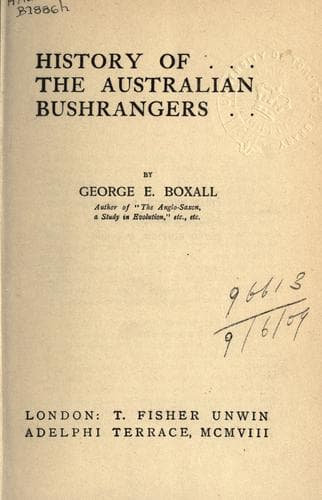
History of the Australian BushrangersBoxall, George
History
History of the Australian Bushrangers
Boxall, George
Bushrangers -- Australia
similar to those described in the previous chapter.
In September, 1866, John Carrol, Patrick Kennagh, Eneas McDonnell,
and John Phegan were sent by the police authorities to the Braidwood
district, to assist the police in the capture of the Clarke gang.
Phegan had been mining in the district and was well acquainted with
the ranges. He paid a visit to Mrs. Clarke, and was received with
some suspicion as a stranger. On his second visit Mrs. Clarke and
her two daughters became quite friendly, and asked Phegan to write
out a petition in favour of her second son James, who was a prisoner
on Cockatoo Island. The party camped as if engaged in surveying, and
Phegan said that Kennagh knew more about writing out petitions than
he did. He therefore took Kennagh to the place and introduced him to
Mrs. Clarke. They wrote out the petition and left. During the next few
days they saw the girls frequently. In the absence of their brothers
these girls looked after the cattle, and were riding about the ranges
every day. They passed the camp several times and spoke in a friendly
manner. On the 4th of October, the party had been pretending to survey
a flat, and under this pretence had searched a gunyah hidden among the
timber. This gunyah was believed to be one of the rendezvous of the
bushrangers, and was closely watched in the hopes that the bushrangers
might visit it. On the day named, the special constables had finished
their work and were standing round the camp fire, when a gun was fired,
and the bullet passed between the men and struck the tree against
which the fire was built. The party had their guns ready and returned
the fire, although they could not see what they were shooting at.
In the morning a flask half full of powder was picked up, but this
gave no indication as to who had attacked the party. After this no
pretence of friendship was made, and Carrol and the party under his
charge openly took up the pursuit of the bushrangers, penetrating the
mountains and searching everywhere where they thought it probable that
the bushrangers might camp. In January, 1867, the bodies of the four
men were found near their camp on the Jinden station in the Jingera
ranges, in the Braidwood district. How or when they were shot is not
known, but it is supposed that they were somehow drawn into an ambush
and shot down. Carrol's body was lying on its back, and a handkerchief
thrown across it with a one pound note pinned to it. The bodies of
Carrol and Kennagh were close together, while the other two were half
a mile away. Three revolvers were lying beside Phegan. One of the men
had £14 on him, and another £19. The bodies were found by Mr. Edward
Smith's stockman when riding through the ranges after cattle, on the
9th January, and as they were in an advanced state of decomposition,
they must have been there for several days. The Governor, Sir John
Young, immediately issued a proclamation, calling upon magistrates,
Public-domain text, read in full here on John Shaqi.
Reviews
Reviews
No reviews yet
Be the first to share your thoughts on this work.
Elsewhere in the archive
Join the Discussion
Join the discussion
Sign in to leave a comment or review.
Sign InorCreate an account