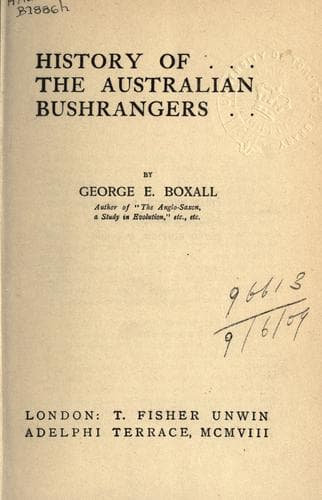
History of the Australian BushrangersBoxall, George
History
History of the Australian Bushrangers
Boxall, George
Bushrangers -- Australia
One of the most notorious of the early bushrangers of Australia was
Edward Davis, commonly known as The Jewboy. Next to Jackey Jackey and,
perhaps, Mathew Brady, more yarns have been told about this hero of
the roads than of any other bushranger in the pre-gold digging era.
The Jewboy gang varied in numbers from time to time, no doubt from
the cause already noted in the cases of Mike Howe and Mathew Brady.
Numbers of runaways joined the gang for a time and then returned to
what was called civilisation, gave themselves up as ordinary runaways,
and "took their fifties like men." Others were shot or captured, and
either hung or sent to a penal settlement to continue their careers
there. The Jewboy appears to have commenced his depredations in 1839 in
what were then the northern districts of the colony of New South Wales.
His range extended from about Maitland to the New England ranges, he
having taken possession of the Great Northern Road, but he was not
particular and, therefore, either he or other members of his gang, or,
perhaps, independent bushrangers who were only supposed to belong to
the Jewboy gang, travelled considerable distances from the road. On
January 12th, 1839, Mr. Biddington's servant was stuck up and robbed
near Mr. Wightman's station on the Namoi River, some distance lower
down than Tamworth. The servant sent an invitation to Mr. Wightman to
"come and have a shot at the bushrangers." The _Sydney Gazette_, of
April 3rd, said: "The country between Patrick's Plains and Maitland
has lately been the scene of numerous outrages by bushrangers. A party
of runaway convicts, armed and mounted, have been scouring the roads
in all directions. In one week they robbed no less than seven teams on
the Wollombi Road, taking away everything portable. They also went to
Mr. Nicholas's house, and carried away a great quantity of property
after destroying a great many articles which they did not want. Mr.
Macdougall, late Chief Constable of Maitland, and a party of volunteers
set out in pursuit. The Wollombi district constable is a tailor by
trade, and he refused to leave his work to accompany the party on the
plea that it would not pay him." This reminds us that the ordinary
police force of the present day did not exist in Australia at that
time. In the larger towns there were paid constables and watchmen who
devoted their whole time to guarding the citizens and their property;
but, in country districts, a tradesman was paid a small sum per annum
for acting as constable. There was, however, a mounted patrol force
which is frequently spoken of as a police force. The police duties in
Sydney, Parramatta, and other large towns were discharged by soldiers.
Public-domain text, read in full here on John Shaqi.
Reviews
Reviews
No reviews yet
Be the first to share your thoughts on this work.
Elsewhere in the archive
Join the Discussion
Join the discussion
Sign in to leave a comment or review.
Sign InorCreate an account