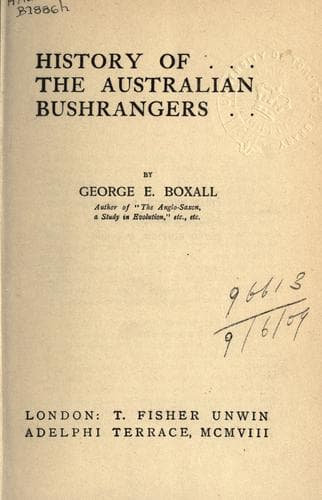
History of the Australian BushrangersBoxall, George
History
History of the Australian Bushrangers
Boxall, George
Bushrangers -- Australia
Charles Vaut and Henry Steele, two of the assigned servants of Mr.
George Furber, worked in the field all day on Saturday, April 24th,
1841, and were seen in the kitchen at eight o'clock at night. On the
following Sunday evening the Rev. John Hill Garvan, residing at Hull
Hill, four miles from Maitland, was sitting at tea just after sunset,
when two men came to the door, presented their guns at him, and said,
"Don't stir." Mrs. Garvan was so much alarmed that she nearly fainted,
and Mr. Garvan asked that she might be allowed to retire to the
bedroom. "Sit still," cried the robber, "or I'll blow your brains out
and put your wife on the fire." Mr. Garvan then struck the smaller man,
Vaut, who was nearest to him, and he snapped his gun at the minister,
but it missed fire. The bigger man then ordered Mrs. Garvan to "go and
sit on the fire." "Oh, don't, pray don't, make me sit on the fire,"
cried the poor woman, but the ruffian took her by the shoulders and
forced her back on to the burning logs. At that moment a dray was heard
coming along the road, and Steele let her go. She was more frightened
than hurt, but her stockings were scorched. The two men then ran away,
and went back to their beds at Mr. Furber's. They were arrested on the
following day by Chief Constable George Wood, of Maitland. A pistol was
found under the sheet of bark which served them for a bedstead. When
brought up for trial, Judge Stephen (afterwards Sir Alfred Stephen),
said the law of England on burglary made no provision for such an
outrage as this, committed in a dwelling before nine o'clock. If they
were convicted they could not be sentenced to more than fifteen years'
imprisonment. The jury found them guilty, and they were sentenced to
the term mentioned. They were afterwards charged with shooting at Mr.
Garvan with intent to do grievous bodily harm, and were found guilty
and sentenced to transportation to a penal settlement for life. It is
more than probable that these men, and many others like them, assisted
the bushrangers whenever an opportunity occurred--that is, when the
bushrangers operated in the neighbourhood in which they were assigned
servants, but without actually becoming members of the gang. There was
a sort of freemasonry among the convicts which impelled them to assist
each other in their war against society, and even in cases where it
was obviously to their interests to stand by and assist their masters,
their sympathies with the bushrangers and their hatred of all forms
of authority impelled them irresistibly to take the opposite side, to
their own individual detriment. But the principal gang having been
broken up in this district, robberies of the kind described gradually
ceased, and it was some years before this district was again disturbed
as it had been. In other districts, however, the bushrangers were still
active.
Public-domain text, read in full here on John Shaqi.
Reviews
Reviews
No reviews yet
Be the first to share your thoughts on this work.
Elsewhere in the archive
Join the Discussion
Join the discussion
Sign in to leave a comment or review.
Sign InorCreate an account