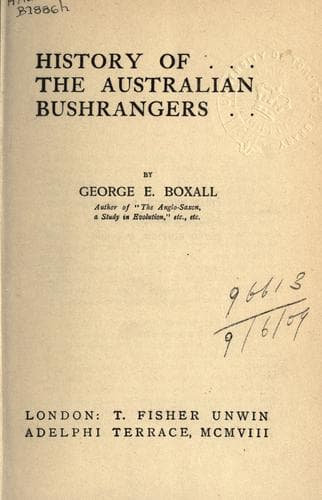
History of the Australian BushrangersBoxall, George
History
History of the Australian Bushrangers
Boxall, George
Bushrangers -- Australia
He sailed for Manilla,
but had to abandon the brig near Formosa, as she leaked heavily. He
and the fifteen men of the crew had taken to the boats and all had
been lost except himself and the three men with him. The boat bore
the name:--"_The Edward_, of London--William Waldon." Although some
doubt was still entertained the Committee arranged for the four men
to be taken to England in the _Charles Grant_. A few days after their
departure another boat with three men on board arrived at Whampoa. The
leader, Huntley, represented himself as having been wrecked in the
brig _Edward_, but said the captain's name was James Wilson and that
she had left London in June, 1828, and gone straight to the Cape. When
near the Ladrones he had quarrelled with Wilson and run away. As the
two accounts differed so materially the former suspicions were revived
and Huntley was sent home under arrest in the _Killie Castle_, and on
the arrival of the _Charles Grant_ in London the three men on board,
John Anderson, Alexander Telford, and Charles Williams, were arrested.
Waldon had landed at Margate, and thus escaped for the time, but was
arrested in London a week or two later. The four men were brought up
at the Thames Police Court on September 22nd, 1830, for examination,
and were charged with piracy. The principal witness was Popjoy, who
had returned to England on receiving his pardon. He identified Huntley
as George James Davis, a convict who had been sentenced to death at
Hobart Town for highway robbery, but whose sentence had been commuted
to penal servitude at Macquarie Harbour. Davis was one of the leaders
of the mutiny when the brig _Cyprus_ had been seized. Alexander
Stevenson, sometimes called Stevie, who now appeared as Telford,
had been convicted in Glasgow in 1824, and had been reconvicted for
bushranging in Australia. John Beveridge, alias Anderson, was sentenced
in Perth in 1821, and was further sentenced in Hobart Town to seven
years' penal servitude for having robbed Mr. Peachey. William Watts,
alias George Williams, was known in Van Diemen's Land as Wattle. He ran
away from a chain gang and took to the bush. He had stabbed one man
and had attempted to shoot another. Of Swallow, Popjoy knew nothing,
but had seen him on board the _Cyprus_ before the mutiny. The boat
which had been sent from China to England was identified by Popjoy as
one belonging to the _Cyprus_, the names _Edward_ and _Waldon_, having
been painted on it since the mutiny. The prisoners were tried at the
Admiralty Court, on November 4th. Popjoy, under cross-examination,
admitted that he had been transported to New South Wales for
horse-stealing. He had been assigned to a master, and had run away.
He had received two hundred lashes at Botany Bay, but this was "only
a few." He had been sent to Van Diemen's Land, and had been charged
with highway robbery near Hobart Town, but had "proved his innocence."
He had "buried in oblivion all the charges" made against him in the
colony.
Public-domain text, read in full here on John Shaqi.
Reviews
Reviews
No reviews yet
Be the first to share your thoughts on this work.
Elsewhere in the archive
Join the Discussion
Join the discussion
Sign in to leave a comment or review.
Sign InorCreate an account