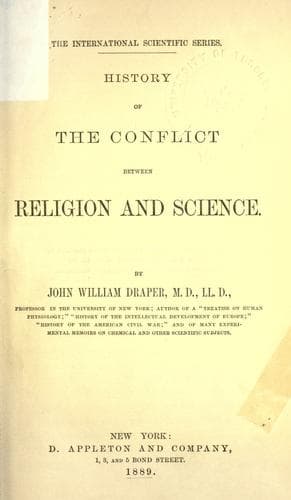
History of the Conflict Between Religion and ScienceDraper, John William
Religion
History of the Conflict Between Religion and Science
Draper, John William
Religion and science -- History
Until Innocent IV. (1243), there was no special tribunal against
heretics, distinct from those of the bishops. The Inquisition, then
introduced, in accordance with the centralization of the times, was
a general and papal tribunal, which displaced the old local ones.
The bishops, therefore, viewed the innovation with great dislike,
considering it as an intrusion on their rights. It was established in
Italy, Spain, Germany, and the southern provinces of France.
The temporal sovereigns were only too desirous to make use of this
powerful engine for their own political purposes. Against this the popes
strongly protested. They were not willing that its use should pass out
of the ecclesiastical hand.
The Inquisition, having already been tried in the south of France, had
there proved to be very effective for the suppression of heresy. It had
been introduced into Aragon. Now was assigned to it the duty of dealing
with the Jews.
In the old times under Visigothic rule these people had greatly
prospered, but the leniency that had been shown to them was succeeded by
atrocious persecution, when the Visigoths abandoned their Arianism and
became orthodox. The most inhuman ordinances were issued against them--a
law was enacted condemning them all to be slaves. It was not to be
wondered at that, when the Saracen invasion took place, the Jews did
whatever they could to promote its success. They, like the Arabs, were
an Oriental people, both traced their lineage to Abraham, their common
ancestor; both were believers in the unity of God. It was their
defense of that doctrine that had brought upon them the hatred of their
Visigothic masters.
Under the Saracen rule they were treated with the highest consideration.
They became distinguished for their wealth and their learning. For
the most part they were Aristotelians. They founded many schools and
colleges. Their mercantile interests led them to travel all over the
world. They particularly studied the science of medicine. Throughout the
middle ages they were the physicians and bankers of Europe. Of all men
they saw the course of human affairs from the most elevated point of
view. Among the special sciences they became proficient in mathematics
and astronomy; they composed the tables of Alfonso, and were the cause
of the voyage of De Gama. They distinguished themselves greatly in light
literature. From the tenth to the fourteenth century their literature
was the first in Europe. They were to be found in the courts of princes
as physicians, or as treasurers managing the public finances.
Public-domain text, read in full here on John Shaqi.
Reviews
Reviews
No reviews yet
Be the first to share your thoughts on this work.
Elsewhere in the archive
Join the Discussion
Join the discussion
Sign in to leave a comment or review.
Sign InorCreate an account