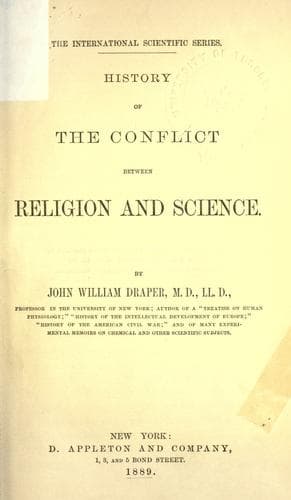
History of the Conflict Between Religion and ScienceDraper, John William
Religion
History of the Conflict Between Religion and Science
Draper, John William
Religion and science -- History
But all these frightful atrocities proved failures. The conversions
were few. Torquemada, therefore, insisted on the immediate banishment
of every unbaptized Jew. On March 30, 1492, the edict of expulsion was
signed. All unbaptized Jews, of whatever age, sex, or condition, were
ordered to leave the realm by the end of the following July. If they
revisited it, they should suffer death. They might sell their effects
and take the proceeds in merchandise or bills of exchange, but not in
gold or silver. Exiled thus suddenly from the land of their birth, the
land of their ancestors for hundreds of years, they could not in
the glutted market that arose sell what they possessed. Nobody would
purchase what could be got for nothing after July. The Spanish clergy
occupied themselves by preaching in the public squares sermons filled
with denunciations against their victims, who, when the time for
expatriation came, swarmed in the roads and filled the air with their
cries of despair. Even the Spanish onlookers wept at the scene of agony.
Torquemada, however, enforced the ordinance that no one should afford
them any help.
Of the banished persons some made their way into Africa, some into
Italy; the latter carried with them to Naples ship-fever, which
destroyed not fewer than twenty thousand in that city, and devastated
that peninsula; some reached Turkey, a few England. Thousands,
especially mothers with nursing children, infants, and old people, died
by the way; many of them in the agonies of thirst.
This action against the Jews was soon followed by one against the Moors.
A pragmatica was issued at Seville, February, 1502, setting forth the
obligations of the Castilians to drive the enemies of God from the land,
and ordering that all unbaptized Moors in the kingdoms of Castile and
Leon above the age of infancy should leave the country by the end of
April. They might sell their property, but not take away any gold or
silver; they were forbidden to emigrate to the Mohammedan dominions; the
penalty of disobedience was death. Their condition was thus worse than
that of the Jews, who had been permitted to go where they chose. Such
was the fiendish intolerance of the Spaniards, that they asserted the
government would be justified in taking the lives of all the Moors for
their shameless infidelity.
What an ungrateful return for the toleration that the Moors in their
day of power had given to the Christians! No faith was kept with the
victims. Granada had surrendered under the solemn guarantee of the full
enjoyment of civil and religious liberty. At the instigation of
Cardinal Ximenes that pledge was broken, and, after a residence of eight
centuries, the Mohammedans were driven out of the land.
Public-domain text, read in full here on John Shaqi.
Reviews
Reviews
No reviews yet
Be the first to share your thoughts on this work.
Elsewhere in the archive
Join the Discussion
Join the discussion
Sign in to leave a comment or review.
Sign InorCreate an account