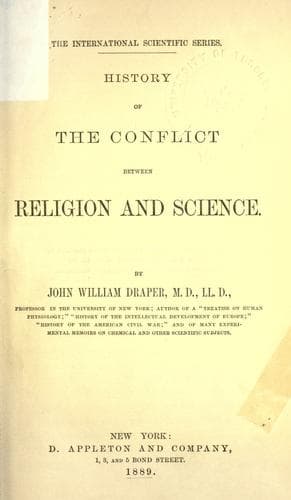
History of the Conflict Between Religion and ScienceDraper, John William
Religion
History of the Conflict Between Religion and Science
Draper, John William
Religion and science -- History
In the genealogy of the family of Shem we have a list of names which are
names, and nothing more to us. It is a genealogy which neither does, nor
pretends to do, more than to trace the order of succession among a few
families only, out of the millions then already existing in the world.
Nothing but this order of succession is given, nor is it at all certain
that this order is consecutive or complete. Nothing is told us of all
that lay behind that curtain of thick darkness, in front of which
these names are made to pass; and yet there are, as it were, momentary
liftings, through which we have glimpses of great movements which were
going on, and had been long going on beyond. No shapes are distinctly
seen. Even the direction of those movements can only be guessed. But
voices are heard which are "as the voices of many waters." I agree in
the opinion of Hupfeld, that "the discovery that the Pentateuch is put
together out of various sources, or original documents, is beyond
all doubt not only one of the most important and most pregnant with
consequences for the interpretation of the historical books of the Old
Testament, or rather for the whole of theology and history, but it is
also one of the most certain discoveries which have been made in
the domain of criticism and the history of literature. Whatever the
anticritical party may bring forward to the contrary, it will maintain
itself, and not retrograde again through any thing, so long as there
exists such a thing as criticism; and it will not be easy for a reader
upon the stage of culture on which we stand in the present day, if he
goes to the examination unprejudiced, and with an uncorrupted power of
appreciating the truth, to be able to ward off its influence."
What then? shall we give up these books? Does not the admission that the
narrative of the fall in Eden is legendary carry with it the surrender
of that most solemn and sacred of Christian doctrines, the atonement?
Let us reflect on this! Christianity, in its earliest days, when it was
converting and conquering the world, knew little or nothing about that
doctrine. We have seen that, in his "Apology," Tertullian did not
think it worth his while to mention it. It originated among the Gnostic
heretics. It was not admitted by the Alexandrian theological school. It
was never prominently advanced by the Fathers. It was not brought into
its present commanding position until the time of Anselm Philo Judaeus
speaks of the story of the fall as symbolical; Origen regarded it as an
allegory. Perhaps some of the Protestant churches may, with reason, be
accused of inconsistency, since in part they consider it as mythical, in
part real. But, if, with them, we admit that the serpent is symbolical
of Satan, does not that cast an air of allegory over the whole
narrative?
Public-domain text, read in full here on John Shaqi.
Reviews
Reviews
No reviews yet
Be the first to share your thoughts on this work.
Elsewhere in the archive
Join the Discussion
Join the discussion
Sign in to leave a comment or review.
Sign InorCreate an account