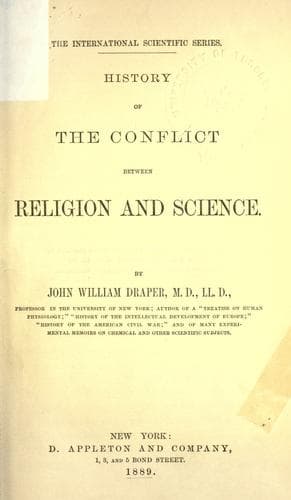
History of the Conflict Between Religion and ScienceDraper, John William
Religion
History of the Conflict Between Religion and Science
Draper, John William
Religion and science -- History
The telescopic observations of Herschel I. satisfied him that there are
very many double stars--double not merely because they are accidentally
in the same line of view, but because they are connected physically,
revolving round each other. These observations were continued and
greatly extended by Herschel II. The elements of the elliptic orbit of
the double star zeta of the Great Bear were determined by Savary, its
period being fifty-eight and one-quarter years; those of another, sigma
Coronae, were determined by Hind, its period being more than seven
hundred and thirty-six years. The orbital movement of these double suns
in ellipses compels us to admit that the law of gravitation holds good
far beyond the boundaries of the solar system; indeed, as far as the
telescope can reach, it demonstrates the reign of law. D'Alembert, in
the Introduction to the Encyclopaedia, says: "The universe is but a
single fact; it is only one great truth."
Shall we, then, conclude that the solar and the starry systems have been
called into existence by God, and that he has then imposed upon them by
his arbitrary will laws under the control of which it was his pleasure
that their movements should be made?
Or are there reasons for believing that these several systems came into
existence not by such an arbitrary fiat, but through the operation of
law?
The following are some peculiarities displayed by the solar system as
enumerated by Laplace. All the planets and their satellites move in
ellipses of such small eccentricity that they are nearly circles. All
the planets move in the same direction and nearly in the same plane. The
movements of the satellites are in the same direction as those of the
planets. The movements of rotation of the sun, of the planets, and the
satellites, are in the same direction as their orbital motions, and in
planes little different.
It is impossible that so many coincidences could be the result of
chance! Is it not plain that there must have been a common tie among
all these bodies, that they are only parts of what must once have been a
single mass?
But if we admit that the substance of which the solar system consists
once existed in a nebulous condition, and was in rotation, all the above
peculiarities follow as necessary mechanical consequences. Nay, more,
the formation of planets, the formation of satellites and of asteroids,
is accounted for. We see why the outer planets and satellites are larger
than the interior ones; why the larger planets rotate rapidly, and the
small ones slowly; why of the satellites the outer planets have more,
the inner fewer. We are furnished with indications of the time of
revolution of the planets in their orbits, and of the satellites in
theirs; we perceive the mode of formation of Saturn's rings. We find an
explanation of the physical condition of the sun, and the transitions of
condition through which the earth and moon have passed, as indicated by
their geology.
Public-domain text, read in full here on John Shaqi.
Reviews
Reviews
No reviews yet
Be the first to share your thoughts on this work.
Elsewhere in the archive
Join the Discussion
Join the discussion
Sign in to leave a comment or review.
Sign InorCreate an account