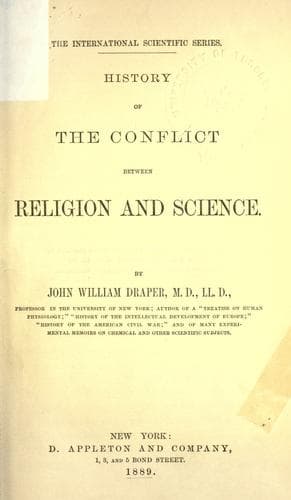
History of the Conflict Between Religion and ScienceDraper, John William
Religion
History of the Conflict Between Religion and Science
Draper, John William
Religion and science -- History
SCIENCE AND CIVILIZATION. In the course of the seventeenth century a
sparse European population had settled along the western Atlantic coast.
Attracted by the cod-fishery of Newfoundland, the French had a little
colony north of the St. Lawrence; the English, Dutch, and Swedes,
occupied the shore of New England and the Middle States; some Huguenots
were living in the Carolinas. Rumors of a spring that could confer
perpetual youth--a fountain of life--had brought a few Spaniards into
Florida. Behind the fringe of villages which these adventurers had
built, lay a vast and unknown country, inhabited by wandering Indians,
whose numbers from the Gulf of Mexico to the St. Lawrence did not exceed
one hundred and eighty thousand. From them the European strangers had
learned that in those solitary regions there were fresh-water seas,
and a great river which they called the Mississippi. Some said that it
flowed through Virginia into the Atlantic, some that it passed through
Florida, some that it emptied into the Pacific, and some that it reached
the Gulf of Mexico. Parted from their native countries by the stormy
Atlantic, to cross which implied a voyage of many months, these refugees
seemed lost to the world.
But before the close of the nineteenth century the descendants of this
feeble people had become one of the great powers of the earth. They
had established a republic whose sway extended from the Atlantic to
the Pacific. With an army of more than a million men, not on paper, but
actually in the field, they had overthrown a domestic assailant.
They had maintained at sea a war-fleet of nearly seven hundred ships,
carrying five thousand guns, some of them the heaviest in the world. The
tonnage of this navy amounted to half a million. In the defense of their
national life they had expended in less than five years more than four
thousand million dollars. Their census, periodically taken, showed that
the population was doubling itself every twenty-five years; it justified
the expectation that at the close of that century it would number nearly
one hundred million souls.
KNOWLEDGE IS POWER. A silent continent had been changed into a scene of
industry; it was full of the din of machinery and the restless moving
of men. Where there had been an unbroken forest, there were hundreds of
cities and towns. To commerce were furnished in profusion some of the
most important staples, as cotton, tobacco, breadstuffs. The mines
yielded incredible quantities of gold, iron, coal. Countless churches,
colleges, and public schools, testified that a moral influence vivified
this material activity. Locomotion was effectually provided for. The
railways exceeded in aggregate length those of all Europe combined.
In 1873 the aggregate length of the European railways was sixty-three
thousand three hundred and sixty miles, that of the American was seventy
thousand six hundred and fifty miles. One of them, built across the
continent, connected the Atlantic and Pacific Oceans.
Public-domain text, read in full here on John Shaqi.
Reviews
Reviews
No reviews yet
Be the first to share your thoughts on this work.
Elsewhere in the archive
Join the Discussion
Join the discussion
Sign in to leave a comment or review.
Sign InorCreate an account