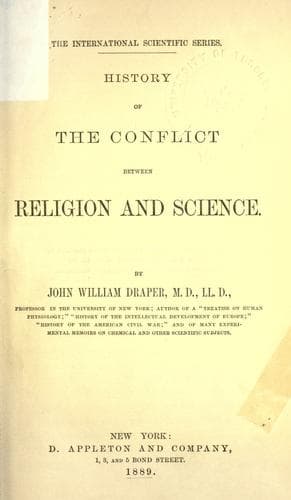
History of the Conflict Between Religion and ScienceDraper, John William
Religion
History of the Conflict Between Religion and Science
Draper, John William
Religion and science -- History
In physical inquiries, its mode of procedure was, to test the value of
any proposed hypothesis, by executing computations in any special case
on the basis or principle of that hypothesis, and then, by performing an
experiment or making an observation, to ascertain whether the result
of these agreed with the result of the computation. If it did not, the
hypothesis was to be rejected.
We may here introduce an illustration or two of this mode of procedure:
THEORIES OF GRAVITATION AND PHLOGISTON. Newton, suspecting that the
influence of the earth's attraction, gravity, may extend as far as the
moon, and be the force that causes her to revolve in her orbit round the
earth, calculated that, by her motion in her orbit, she was deflected
from the tangent thirteen feet every minute; but, by ascertaining the
space through which bodies would fall in one minute at the earth's
surface, and supposing it to be diminished in the ratio of the inverse
square, it appeared that the attraction at the moon's orbit would draw
a body through more than fifteen feet. He, therefore, for the time,
considered his hypothesis as unsustained. But it so happened that Picard
shortly afterward executed more correctly a new measurement of a degree;
this changed the estimated magnitude of the earth, and the distance of
the moon, which was measured in earth-semidiameters. Newton now renewed
his computation, and, as I have related on a previous page, as it drew
to a close, foreseeing that a coincidence was about to be established,
was so much agitated that he was obliged to ask a friend to complete it.
The hypothesis was sustained.
A second instance will sufficiently illustrate the method under
consideration. It is presented by the chemical theory of phlogiston.
Stahl, the author of this theory, asserted that there is a principle of
inflammability, to which he gave the name phlogiston, having the quality
of uniting with substances. Thus, when what we now term a metallic oxide
was united to it, a metal was produced; and, if the phlogiston were
withdrawn, the metal passed back into its earthy or oxidized state. On
this principle, then, the metals were compound bodies, earths combined
with phlogiston.
SCIENCE AND ECCLESIASTICISM. But during the eighteenth century the
balance was introduced as an instrument of chemical research. Now, if
the phlogistic hypothesis be true, it would follow that a metal should
be the heavier, its oxide the lighter body, for the former contains
something--phlogiston--that has been added to the latter. But, on
weighing a portion of any metal, and also the oxide producible from it,
the latter proves to be the heavier, and here the phlogistic hypothesis
fails. Still further, on continuing the investigation, it may be shown
that the oxide or calx, as it used to be called, has become heavier by
combining with one of the ingredients of the air.
Public-domain text, read in full here on John Shaqi.
Reviews
Reviews
No reviews yet
Be the first to share your thoughts on this work.
Elsewhere in the archive
Join the Discussion
Join the discussion
Sign in to leave a comment or review.
Sign InorCreate an account