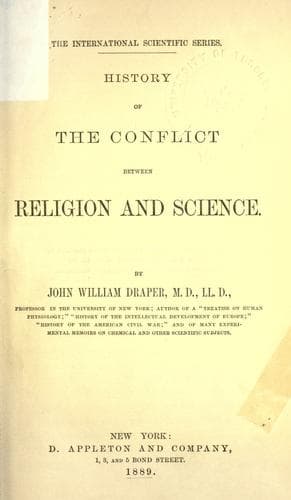
History of the Conflict Between Religion and ScienceDraper, John William
Religion
History of the Conflict Between Religion and Science
Draper, John William
Religion and science -- History
THE ROYAL SOCIETY OF LONDON. We have only to turn over the pages of its
Transactions to discern how much this society has done for the progress
of humanity. It was incorporated in 1662, and has interested itself in
all the great scientific movements and discoveries that have since been
made. It published Newton's "Principia;" it promoted Halley's voyage,
the first scientific expedition undertaken by any government; it made
experiments on the transfusion of blood, and accepted Harvey's discovery
of the circulation. The encouragement it gave to inoculation led Queen
Caroline to beg six condemned criminals for experiment, and then to
submit her own children to that operation. Through its encouragement
Bradley accomplished his great discovery, the aberration of the fixed
stars, and that of the nutation of the earth's axis; to these two
discoveries, Delambre says, we owe the exactness of modern astronomy. It
promoted the improvement of the thermometer, the measure of temperature,
and in Harrison's watch, the chronometer, the measure of time. Through
it the Gregorian Calendar was introduced into England, in 1752, against
a violent religious opposition. Some of its Fellows were pursued through
the streets by an ignorant and infuriated mob, who believed it had
robbed them of eleven days of their lives; it was found necessary to
conceal the name of Father Walmesley, a learned Jesuit, who had taken
deep interest in the matter; and, Bradley happening to die during the
commotion, it was declared that he had suffered a judgment from Heaven
for his crime!
Public-domain text, read in full here on John Shaqi.
Reviews
Reviews
No reviews yet
Be the first to share your thoughts on this work.
Elsewhere in the archive
Join the Discussion
Join the discussion
Sign in to leave a comment or review.
Sign InorCreate an account