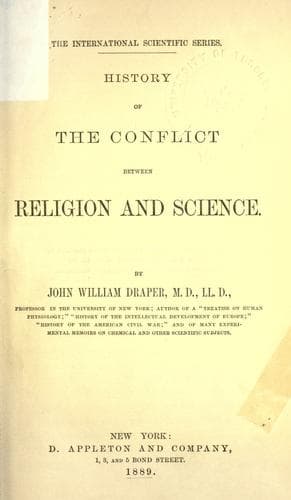
History of the Conflict Between Religion and ScienceDraper, John William
Religion
History of the Conflict Between Religion and Science
Draper, John William
Religion and science -- History
When the Mohammedan discovery of inoculation was brought from
Constantinople in 1721, by Lady Mary Wortley Montagu, it was so
strenuously resisted by the clergy, that nothing short of its adoption
by the royal family of England brought it into use. A similar resistance
was exhibited when Jenner introduced his great improvement, vaccination;
yet a century ago it was the exception to see a face unpitted by
smallpox--now it is the exception to see one so disfigured. In like
manner, when the great American discovery of anaesthetics was applied
in obstetrical cases, it was discouraged, not so much for physiological
reasons, as under the pretense that it was an impious attempt to escape
from the curse denounced against all women in Genesis iii. 16.
MAGIC AND MIRACLES. Inventive ingenuity did not restrict itself to the
production of useful contrivances, it added amusing ones. Soon after the
introduction of science into Italy, the houses of the virtuosi began to
abound in all kinds of curious mechanical surprises, and, as they
were termed, magical effects. In the latter the invention of the
magic-lantern greatly assisted. Not without reason did the ecclesiastics
detest experimental philosophy, for a result of no little importance
ensued--the juggler became a successful rival to the miracle-worker. The
pious frauds enacted in the churches lost their wonder when brought
into competition with the tricks of the conjurer in the market-place: he
breathed flame, walked on burning coals, held red-hot iron in his
teeth, drew basketfuls of eggs out of his mouth, worked miracles by
marionettes. Yet the old idea of the supernatural was with difficulty
destroyed. A horse, whose master had taught him many tricks, was tried
at Lisbon in 1601, found guilty of being, possessed by the devil, and
was burnt. Still later than that many witches were brought to the stake.
Public-domain text, read in full here on John Shaqi.
Reviews
Reviews
No reviews yet
Be the first to share your thoughts on this work.
Elsewhere in the archive
Join the Discussion
Join the discussion
Sign in to leave a comment or review.
Sign InorCreate an account