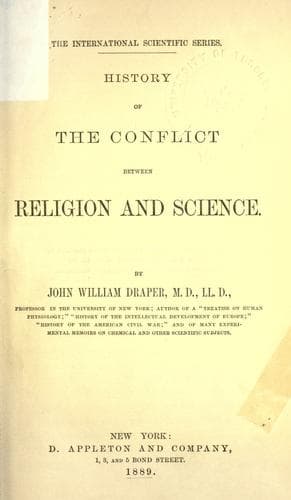
History of the Conflict Between Religion and ScienceDraper, John William
Religion
History of the Conflict Between Religion and Science
Draper, John William
Religion and science -- History
CHRISTIANITY UNDER CONSTANTINE. 2. To the emperor--a mere worldling--a
man without any religious convictions, doubtless it appeared best for
himself, best for the empire, and best for the contending parties,
Christian and pagan, to promote their union or amalgamation as much as
possible. Even sincere Christians do not seem to have been averse to
this; perhaps they believed that the new doctrines would diffuse most
thoroughly by incorporating in themselves ideas borrowed from the old,
that Truth would assert her self in the end, and the impurity be cast
off. In accomplishing this amalgamation, Helena, the empress-mother,
aided by the court ladies, led the way. For her gratification there were
discovered, in a cavern at Jerusalem, wherein they had lain buried for
more than three centuries, the Savior's cross, and those of the two
thieves, the inscription, and the nails that had been used. They were
identified by miracle. A true relic-worship set in. The superstition of
the old Greek times reappeared; the times when the tools with which the
Trojan horse was made might still be seen at Metapontum, the sceptre of
Pelops at Chaeroneia, the spear of Achilles at Phaselis, the sword
of Memnon at Nicomedia, when the Tegeates could show the hide of the
Calydonian boar and very many cities boasted their possession of the
true palladium of Troy; when there were statues of Minerva that could
brandish spears, paintings that could blush, images that could sweat,
and endless shrines and sanctuaries at which miracle-cures could be
performed.
As years passed on, the faith described by Tertullian was transmuted
into one more fashionable and more debased. It was incorporated with
the old Greek mythology. Olympus was restored, but the divinities passed
under other names. The more powerful provinces insisted on the adoption
of their time-honored conceptions. Views of the Trinity, in accordance
with Egyptian traditions, were established. Not only was the adoration
of Isis under a new name restored, but even her image, standing on the
crescent moon, reappeared. The well-known effigy of that goddess,
with the infant Horus in her arms, has descended to our days in
the beautiful, artistic creations of the Madonna and Child. Such
restorations of old conceptions under novel forms were everywhere
received with delight. When it was announced to the Ephesians that the
Council of that place, headed by Cyril, had decreed that the Virgin
should be called "the Mother of God," with tears of joy they embraced
the knees of their bishop; it was the old instinct peeping out; their
ancestors would have done the same for Diana.
Public-domain text, read in full here on John Shaqi.
Reviews
Reviews
No reviews yet
Be the first to share your thoughts on this work.
Join the Discussion
Join the discussion
Sign in to leave a comment or review.
Sign InorCreate an account