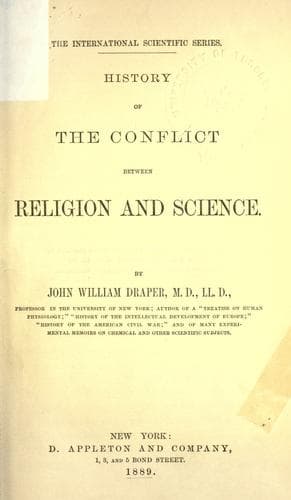
History of the Conflict Between Religion and ScienceDraper, John William
Religion
History of the Conflict Between Religion and Science
Draper, John William
Religion and science -- History
From Tertullian's able work we see what Christianity was while it was
suffering persecution and struggling for existence. We have now to
see what it became when in possession of imperial power. Great is the
difference between Christianity under Severus and Christianity after
Constantine. Many of the doctrines which at the latter period were
preeminent, in the former were unknown.
PAGANIZATION OF CHRISTIANITY. Two causes led to the amalgamation of
Christianity with paganism: 1. The political necessities of the new
dynasty; 2. The policy adopted by the new religion to insure its spread.
1. Though the Christian party had proved itself sufficiently strong to
give a master to the empire, it was never sufficiently strong to destroy
its antagonist, paganism. The issue of the struggle between them was an
amalgamation of the principles of both. In this, Christianity differed
from Mohammedanism, which absolutely annihilated its antagonist, and
spread its own doctrines without adulteration.
Constantine continually showed by his acts that he felt he must be the
impartial sovereign of all his people, not merely the representative
of a successful faction. Hence, if he built Christian churches, he also
restored pagan temples; if he listened to the clergy, he also consulted
the haruspices; if he summoned the Council of Nicea, he also honored the
statue of Fortune; if he accepted the rite of baptism, he also struck
a medal bearing his title of "God." His statue, on the top of the great
porphyry pillar at Constantinople, consisted of an ancient image of
Apollo, whose features were replaced by those of the emperor, and
its head surrounded by the nails feigned to have been used at the
crucifixion of Christ, arranged so as to form a crown of glory.
Feeling that there must be concessions to the defeated pagan party,
in accordance with its ideas, he looked with favor on the idolatrous
movements of his court. In fact, the leaders of these movements were
persons of his own family.
Public-domain text, read in full here on John Shaqi.
Reviews
Reviews
No reviews yet
Be the first to share your thoughts on this work.
Join the Discussion
Join the discussion
Sign in to leave a comment or review.
Sign InorCreate an account