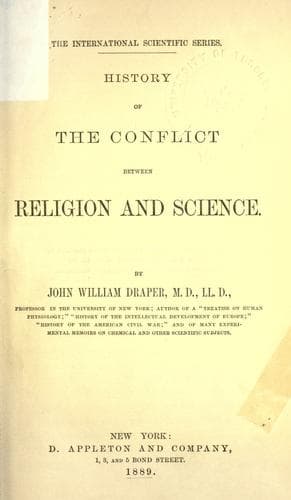
History of the Conflict Between Religion and ScienceDraper, John William
Religion
History of the Conflict Between Religion and Science
Draper, John William
Religion and science -- History
At this time the bishopric of Alexandria was held by one Theophilus. An
ancient temple of Osiris having been given to the Christians of the city
for the site of a church, it happened that, in digging the foundation
for the new edifice, the obscene symbols of the former worship chanced
to be found. These, with more zeal than modesty, Theophilus exhibited
in the market-place to public derision. With less forbearance than the
Christian party showed when it was insulted in the theatre during the
Trinitarian dispute, the pagans resorted to violence, and a riot ensued.
They held the Serapion as their headquarters. Such were the disorder and
bloodshed that the emperor had to interfere. He dispatched a rescript to
Alexandria, enjoining the bishop, Theophilus, to destroy the Serapion;
and the great library, which had been collected by the Ptolemies, and
had escaped the fire of Julius Caesar, was by that fanatic dispersed.
THE MURDER OF HYPATIA. The bishopric thus held by Theophilus was in due
time occupied by his nephew St. Cyril, who had commended himself to
the approval of the Alexandrian congregations as a successful and
fashionable preacher. It was he who had so much to do with the
introduction of the worship of the Virgin Mary. His hold upon the
audiences of the giddy city was, however, much weakened by Hypatia, the
daughter of Theon, the mathematician, who not only distinguished herself
by her expositions of the doctrines of Plato and Aristotle, but also by
her comments on the writings of Apollonius and other geometers. Each day
before her academy stood a long train of chariots; her lecture-room was
crowded with the wealth and fashion of Alexandria. They came to listen
to her discourses on those questions which man in all ages has asked,
but which never yet have been answered: "What am I? Where am I? What can
I know?"
Hypatia and Cyril! Philosophy and bigotry. They cannot exist together.
So Cyril felt, and on that feeling he acted. As Hypatia repaired to her
academy, she was assaulted by Cyril's mob--a mob of many monks. Stripped
naked in the street, she was dragged into a church, and there killed by
the club of Peter the Reader. The corpse was cut to pieces, the flesh
was scraped from the bones with shells, and the remnants cast into a
fire. For this frightful crime Cyril was never called to account. It
seemed to be admitted that the end sanctified the means.
So ended Greek philosophy in Alexandria, so came to an untimely close
the learning that the Ptolemies had done so much to promote. The
"Daughter Library," that of the Serapion, had been dispersed. The fate
of Hypatia was a warning to all who would cultivate profane knowledge.
Henceforth there was to be no freedom for human thought. Every one must
think as the ecclesiastical authority ordered him, A.D. 414. In Athens
itself philosophy awaited its doom. Justinian at length prohibited its
teaching, and caused all its schools in that city to be closed.
Public-domain text, read in full here on John Shaqi.
Reviews
Reviews
No reviews yet
Be the first to share your thoughts on this work.
Elsewhere in the archive
Join the Discussion
Join the discussion
Sign in to leave a comment or review.
Sign InorCreate an account