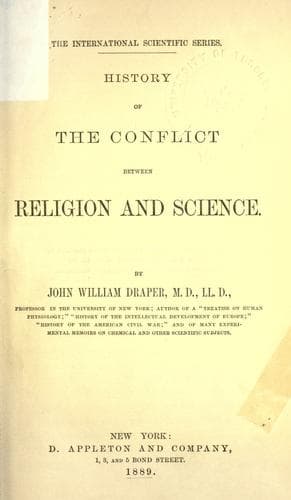
History of the Conflict Between Religion and ScienceDraper, John William
Religion
History of the Conflict Between Religion and Science
Draper, John William
Religion and science -- History
PELAGIUS. While these events were transpiring in the Eastern provinces
of the Roman Empire, the spirit that had produced them was displaying
itself in the West. A British monk, who had assumed the name of
Pelagius, passed through Western Europe and Northern Africa, teaching
that death was not introduced into the world by the sin of Adam; that
on the contrary he was necessarily and by nature mortal, and had he not
sinned he would nevertheless have died; that the consequences of his
sins were confined to himself, and did not affect his posterity. From
these premises Pelagius drew certain important theological conclusions.
At Rome, Pelagius had been received with favor; at Carthage, at the
instigation of St. Augustine, he was denounced. By a synod, held at
Diospolis, he was acquitted of heresy, but, on referring the matter to
the Bishop of Rome, Innocent I., he was, on the contrary, condemned. It
happened that at this moment Innocent died, and his successor, Zosimus,
annulled his judgment and declared the opinions of Pelagius to be
orthodox. These contradictory decisions are still often referred to
by the opponents of papal infallibility. Things were in this state of
confusion, when the wily African bishops, through the influence of Count
Valerius, procured from the emperor an edict denouncing Pelagins as
a heretic; he and his accomplices were condemned to exile and the
forfeiture of their goods. To affirm that death was in the world before
the fall of Adam, was a state crime.
CONDEMNATION OF PELAGIUS. It is very instructive to consider the
principles on which this strange decision was founded. Since the
question was purely philosophical, one might suppose that it would
have been discussed on natural principles; instead of that, theological
considerations alone were adduced. The attentive reader will have
remarked, in Tertullian's statement of the principles of Christianity,
a complete absence of the doctrines of original sin, total depravity,
predestination, grace, and atonement. The intention of Christianity,
as set forth by him, has nothing in common with the plan of salvation
upheld two centuries subsequently. It is to St. Augustine, a
Carthaginian, that we are indebted for the precision of our views on
these important points.
In deciding whether death had been in the world before the fall of Adam,
or whether it was the penalty inflicted on the world for his sin,
the course taken was to ascertain whether the views of Pelagius were
accordant or discordant not with Nature but with the theological
doctrines of St. Augustine. And the result has been such as might
be expected. The doctrine declared to be orthodox by ecclesiastical
authority is overthrown by the unquestionable discoveries of modern
science. Long before a human being had appeared upon earth, millions of
individuals--nay, more, thousands of species and even genera--had died;
those which remain with us are an insignificant fraction of the vast
hosts that have passed away.
Public-domain text, read in full here on John Shaqi.
Reviews
Reviews
No reviews yet
Be the first to share your thoughts on this work.
Elsewhere in the archive
Join the Discussion
Join the discussion
Sign in to leave a comment or review.
Sign InorCreate an account