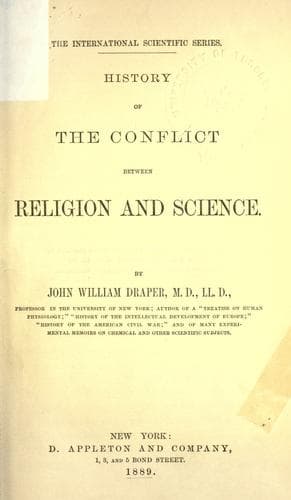
History of the Conflict Between Religion and ScienceDraper, John William
Religion
History of the Conflict Between Religion and Science
Draper, John William
Religion and science -- History
"But," he adds, "some one may ask, 'What was God doing before he made
the heaven and the earth? for, if at any particular moment he began
to employ himself, that means time, not eternity. In eternity nothing
transpires--the whole is present.'" In answering this question, he
cannot forbear one of those touches of rhetoric for which he was so
celebrated: "I will not answer this question by saying that he was
preparing hell for priers into his mysteries. I say that, before God
made heaven and earth, he did not make any thing, for no creature could
be made before any creature was made. Time itself is a creature, and
hence it could not possibly exist before creation.
"What, then, is time? The past is not, the future is not, the
present--who can tell what it is, unless it be that which has no
duration between two nonentities? There is no such thing as 'a long
time,' or 'a short time,' for there are no such things as the past and
the future. They have no existence, except in the soul."
The style in which St. Augustine conveyed his ideas is that of a
rhapsodical conversation with God. His works are an incoherent dream.
That the reader may appreciate this remark, I might copy almost at
random any of his paragraphs. The following is from the twelfth book:
"This then, is what I conceive, O my God, when I hear thy Scripture
saying, In the beginning God made heaven and earth: and the earth was
invisible and without form, and darkness was upon the deep, and not
mentioning what day thou createdst them; this is what I conceive,
that because of the heaven of heavens--that intellectual heaven, whose
intelligences know all at once, not in part, not darkly, not through a
glass, but as a whole, in manifestation, face to face; not this thing
now, and that thing anon; but (as I said) know all at once, without any
succession of times; and because of the earth, invisible and without
form, without any succession of times, which succession presents 'this
thing now, that thing anon;' because, where there is no form, there
is no distinction of things; it is, then, on account of these two, a
primitive formed, and a primitive formless; the one, heaven, but the
heaven of heavens; the other, earth, but the earth movable and without
form; because of these two do I conceive, did thy Scripture say without
mention of days, In the beginning God created the heaven and the earth.
For, forthwith it subjoined what earth it spake of; and also in that the
firmament is recorded to be created the second day, and called heaven,
it conveys to us of which heaven he before spake, without mention of
days.
Public-domain text, read in full here on John Shaqi.
Reviews
Reviews
No reviews yet
Be the first to share your thoughts on this work.
Elsewhere in the archive
Join the Discussion
Join the discussion
Sign in to leave a comment or review.
Sign InorCreate an account