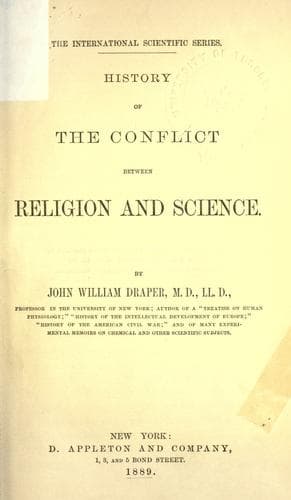
History of the Conflict Between Religion and ScienceDraper, John William
Religion
History of the Conflict Between Religion and Science
Draper, John William
Religion and science -- History
"Wondrous depth of thy words! whose surface behold! is before us,
inviting to little ones; yet are they a wondrous depth, O my God, a
wondrous depth! It is awful to look therein; an awfulness of honor, and
a trembling of love. The enemies thereof I hate vehemently; O that thou
wouldst slay them with thy two-edged sword, that they might no longer be
enemies to it: for so do I love to have them slain unto themselves, that
they may live unto thee."
As an example of the hermeneutical manner in which St. Augustine
unfolded the concealed facts of the Scriptures, I may cite the following
from the thirteenth book of the "Confessions;" his object is to show
that the doctrine of the Trinity is contained in the Mosaic narrative of
the creation:
"Lo, now the Trinity appears unto me in a glass darkly, which is thou my
God, because thou, O Father, in him who is the beginning of our wisdom,
which is thy wisdom, born of thyself, equal unto thee and coeternal,
that is, in thy Son, createdst heaven and earth. Much now have we said
of the heaven of heavens, and of the earth invisible and without form,
and of the darksome deep, in reference to the wandering instability of
its spiritual deformity, unless it had been converted unto him, from
whom it had its then degree of life, and by his enlightening became a
beauteous life, and the heaven of that heaven, which was afterward
set between water and water. And under the name of God, I now held the
Father, who made these things; and under the name of the beginning, the
Son, in whom he made these things; and believing, as I did, my God as
the Trinity, I searched further in his holy words, and lo! thy Spirit
moved upon the waters. Behold the Trinity, my God!--Father, and Son, and
Holy Ghost Creator of all creation."
That I might convey to my reader a just impression of the character of
St. Augustine's philosophical writings, I have, in the two quotations
here given, substituted for my own translation that of the Rev. Dr.
Pusey, as contained in Vol. I. of the "Library of Fathers of the Holy
Catholic Church," published at Oxford, 1840.
Public-domain text, read in full here on John Shaqi.
Reviews
Reviews
No reviews yet
Be the first to share your thoughts on this work.
Elsewhere in the archive
Join the Discussion
Join the discussion
Sign in to leave a comment or review.
Sign InorCreate an account