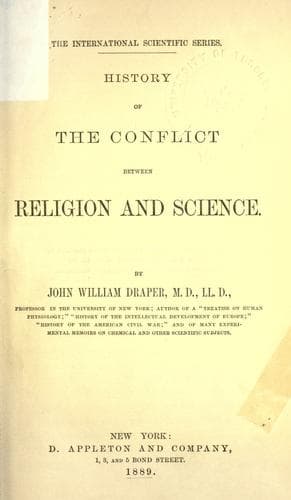
History of the Conflict Between Religion and ScienceDraper, John William
Religion
History of the Conflict Between Religion and Science
Draper, John William
Religion and science -- History
From this catastrophe Noah and his three sons, with their wives, were
saved in an ark. Of these sons, Shem remained in Asia and repeopled it.
Ham peopled Africa; Japhet, Europe. As the Fathers were not acquainted
with the existence of America, they did not provide an ancestor for its
people.
Let us listen to what some of these authorities say in support of their
assertions. Thus Lactantius, referring to the heretical doctrine of the
globular form of the earth, remarks: "Is it possible that men can be so
absurd as to believe that the crops and the trees on the other side of
the earth hang downward, and that men have their feet higher than their
heads? If you ask them how they defend these monstrosities, how things
do not fall away from the earth on that side, they reply that the nature
of things is such that heavy bodies tend toward the centre, like the
spokes of a wheel, while light bodies, as clouds, smoke, fire, tend from
the centre to the heavens on all sides. Now, I am really at a loss what
to say of those who, when they have once gone wrong, steadily persevere
in their folly, and defend one absurd opinion by another." On the
question of the antipodes, St. Augustine asserts that "it is impossible
there should be inhabitants on the opposite side of the earth, since
no such race is recorded by Scripture among the descendants of Adam."
Perhaps, however, the most unanswerable argument against the sphericity
of the earth was this, that "in the day of judgment, men on the other
side of a globe could not see the Lord descending through the air."
It is unnecessary for me to say any thing respecting the introduction of
death into the world, the continual interventions of spiritual agencies
in the course of events, the offices of angels and devils, the expected
conflagration of the earth, the tower of Babel, the confusion of
tongues, the dispersion of mankind, the interpretation of natural
phenomena, as eclipses, the rainbow, etc. Above all, I abstain from
commenting on the Patristic conceptions of the Almighty; they are too
anthropomorphic, and wanting in sublimity.
Public-domain text, read in full here on John Shaqi.
Reviews
Reviews
No reviews yet
Be the first to share your thoughts on this work.
Elsewhere in the archive
Join the Discussion
Join the discussion
Sign in to leave a comment or review.
Sign InorCreate an account