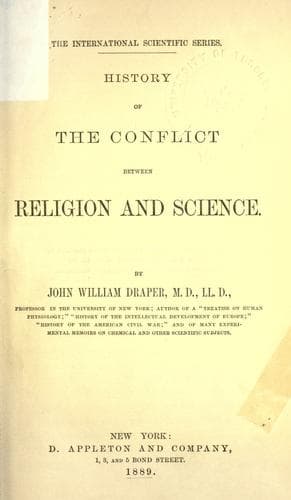
History of the Conflict Between Religion and ScienceDraper, John William
Religion
History of the Conflict Between Religion and Science
Draper, John William
Religion and science -- History
Perhaps, however, I may quote from Cosmas Indicopleustes the views
that were entertained in the sixth century. He wrote a work entitled
"Christian Topography," the chief intent of which was to confute the
heretical opinion of the globular form of the earth, and the pagan
assertion that there is a temperate zone on the southern side of the
torrid. He affirms that, according to the true orthodox system of
geography, the earth is a quadrangular plane, extending four hundred
days' journey east and west, and exactly half as much north and south;
that it is inclosed by mountains, on which the sky rests; that one on
the north side, huger than the others, by intercepting the rays of the
sun, produces night; and that the plane of the earth is not set exactly
horizontally, but with a little inclination from the north: hence the
Euphrates, Tigris, and other rivers, running southward, are rapid; but
the Nile, having to run up-hill, has necessarily a very slow current.
The Venerable Bede, writing in the seventh century, tells us that "the
creation was accomplished in six days, and that the earth is its centre
and its primary object. The heaven is of a fiery and subtile nature,
round, and equidistant in every part, as a canopy from the centre of the
earth. It turns round every day with ineffable rapidity, only moderated
by the resistance of the seven planets, three above the sun--Saturn,
Jupiter, Mars--then the sun; three below--Venus, Mercury, the moon. The
stars go round in their fixed courses, the northern perform the shortest
circle. The highest heaven has its proper limit; it contains the angelic
virtues who descend upon earth, assume ethereal bodies, perform human
functions, and return. The heaven is tempered with glacial waters, lest
it should be set on fire. The inferior heaven is called the firmament,
because it separates the superincumbent waters from the waters below.
The firmamental waters are lower than the spiritual heaven, higher than
all corporeal beings, reserved, some say, for a second deluge; others,
more truly, to temper the fire of the fixed stars."
Was it for this preposterous scheme--this product of ignorance and
audacity--that the works of the Greek philosophers were to be given
up? It was none too soon that the great critics who appeared at the
Reformation, by comparing the works of these writers with one another,
brought them to their proper level, and taught us to look upon them all
with contempt.
Public-domain text, read in full here on John Shaqi.
Reviews
Reviews
No reviews yet
Be the first to share your thoughts on this work.
Elsewhere in the archive
Join the Discussion
Join the discussion
Sign in to leave a comment or review.
Sign InorCreate an account