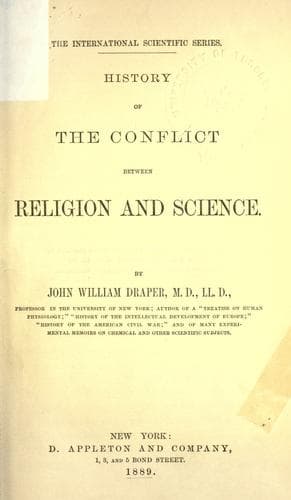
History of the Conflict Between Religion and ScienceDraper, John William
Religion
History of the Conflict Between Religion and Science
Draper, John William
Religion and science -- History
INVASION OF CHOSROES Though her military renown was thus recovered,
though her territory was regained, there was something that the Roman
Empire had irrecoverably lost. Religious faith could never be restored.
In face of the world Magianism had insulted Christianity, by profaning
her most sacred places--Bethlehem, Gethsemane, Calvary--by burning
the sepulchre of Christ, by rifling and destroying the churches, by
scattering to the winds priceless relics, by carrying off, with shouts
of laughter, the cross.
Miracles had once abounded in Syria, in Egypt, in Asia Minor; there was
not a church which had not its long catalogue of them. Very often they
were displayed on unimportant occasions and in insignificant cases. In
this supreme moment, when such aid was most urgently demanded, not a
miracle was worked.
Amazement filled the Christian populations of the East when they
witnessed these Persian sacrileges perpetrated with impunity. The
heavens should have rolled asunder, the earth should have opened her
abysses, the sword of the Almighty should have flashed in the sky, the
fate of Sennacherib should have been repeated. But it was not so. In the
land of miracles, amazement was followed by consternation--consternation
died out in disbelief.
2. But, dreadful as it was, the Persian conquest was but a prelude to
the great event, the story of which we have now to relate--the Southern
revolt against Christianity. Its issue was the loss of nine-tenths of
her geographical possessions--Asia, Africa, and part of Europe.
MOHAMMED. In the summer of 581 of the Christian era, there came to
Bozrah, a town on the confines of Syria, south of Damascus, a caravan
of camels. It was from Mecca, and was laden with the costly products of
South Arabia--Arabia the Happy. The conductor of the caravan, one Abou
Taleb, and his nephew, a lad of twelve years, were hospitably received
and entertained at the Nestorian convent of the town.
The monks of this convent soon found that their young visitor, Halibi or
Mohammed, was the nephew of the guardian of the Caaba, the sacred temple
of the Arabs. One of them, by name Bahira, spared no pains to secure his
conversion from the idolatry in which he had been brought up. He found
the boy not only precociously intelligent, but eagerly desirous of
information, especially on matters relating to religion.
In Mohammed's own country the chief object of Meccan worship was a
black meteoric stone, kept in the Caaba, with three hundred and sixty
subordinate idols, representing the days of the year, as the year was
then counted.
Public-domain text, read in full here on John Shaqi.
Reviews
Reviews
No reviews yet
Be the first to share your thoughts on this work.
Elsewhere in the archive
Join the Discussion
Join the discussion
Sign in to leave a comment or review.
Sign InorCreate an account