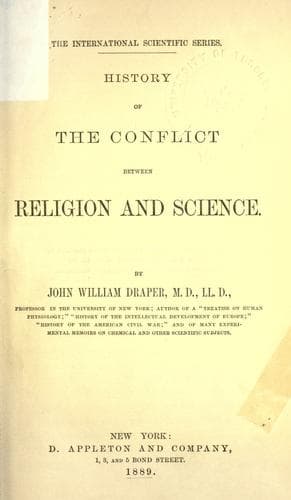
History of the Conflict Between Religion and ScienceDraper, John William
Religion
History of the Conflict Between Religion and Science
Draper, John William
Religion and science -- History
By the monk Bahira, in the convent at Bozrah, Mohammed was taught the
tenets of the Nestorians; from them the young Arab learned the story of
their persecutions. It was these interviews which engendered in him a
hatred of the idolatrous practices of the Eastern Church, and indeed of
all idolatry; that taught him, in his wonderful career, never to speak
of Jesus as the Son of God, but always as "Jesus, the son of Mary." His
untutored but active mind could not fail to be profoundly impressed not
only with the religious but also with the philosophical ideas of
his instructors, who gloried in being the living representatives of
Aristotelian science. His subsequent career shows how completely their
religious thoughts had taken possession of him, and repeated acts
manifest his affectionate regard for them. His own life was devoted to
the expansion and extension of their theological doctrine, and, that
once effectually established, his successors energetically adopted and
diffused their scientific, their Aristotelian opinions.
As Mohammed grew to manhood, he made other expeditions to Syria.
Perhaps, we may suppose, that on these occasions the convent and its
hospitable in mates were not forgotten. He had a mysterious reverence
for that country. A wealthy Meccan widow Chadizah, had intrusted him
with the care of her Syrian trade. She was charmed with his capacity
and fidelity, and (since he is said to have been characterized by the
possession of singular manly beauty and a most courteous demeanor)
charmed with his person. The female heart in all ages and countries is
the same. She caused a slave to intimate to him what was passing in her
mind, and, for the remaining twenty-four years of her life, Mohammed was
her faithful husband. In a land of polygamy, he never insulted her by
the presence of a rival. Many years subsequently, in the height of his
power, Ayesha, who was one of the most beautiful women in Arabia, said
to him: "Was she not old? Did not God give you in me a better wife in
her place?" "No, by God!" exclaimed Mohammed, and with a burst of honest
gratitude, "there never can be a better. She believed in me when men
despised me, she relieved me when I was poor and persecuted by the
world."
His marriage with Chadizah placed him in circumstances of ease, and gave
him an opportunity of indulging his inclination to religious meditation.
It so happened that her cousin Waraka, who was a Jew, had turned
Christian. He was the first to translate the Bible into Arabic. By his
conversation Mohammed's detestation of idolatry was confirmed.
Public-domain text, read in full here on John Shaqi.
Reviews
Reviews
No reviews yet
Be the first to share your thoughts on this work.
Elsewhere in the archive
Join the Discussion
Join the discussion
Sign in to leave a comment or review.
Sign InorCreate an account