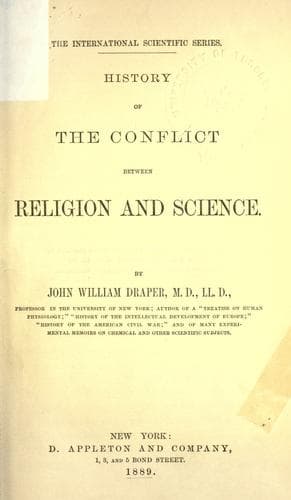
History of the Conflict Between Religion and ScienceDraper, John William
Religion
History of the Conflict Between Religion and Science
Draper, John William
Religion and science -- History
His public ministrations met with much resistance and little success at
first. Expelled from Mecca by the upholders of the prevalent idolatry,
he sought refuge in Medina, a town in which there were many Jews and
Nestorians; the latter at once became proselytes to his faith. He had
already been compelled to send his daughter and others of his disciples
to Abyssinia, the king of which was a Nestorian Christian. At the end of
six years he had made only fifteen hundred converts. But in three little
skirmishes, magnified in subsequent times by the designation of the
battles of Beder, of Ohud, and of the Nations, Mohammed discovered that
his most convincing argument was his sword. Afterward, with Oriental
eloquence, he said, "Paradise will be found in the shadow of the
crossing of swords." By a series of well-conducted military operations,
his enemies were completely overthrown. Arabian idolatry was absolutely
exterminated; the doctrine he proclaimed, that "there is but one God,"
was universally adopted by his countrymen, and his own apostleship
accepted.
DEATH OF MOHAMMED. Let us pass over his stormy life, and hear what
he says when, on the pinnacle of earthly power and glory, he was
approaching its close.
Steadfast in his declaration of the unity of God, he departed from
Medina on his last pilgrimage to Mecca, at the head of one hundred
and fourteen thousand devotees, with camels decorated with garlands of
flowers and fluttering streamers. When he approached the holy city, he
uttered the solemn invocation: "Here am I in thy service, O God! Thou
hast no companion. To thee alone belongeth worship. Thine alone is the
kingdom. There is none to share it with thee."
With his own hand he offered up the camels in sacrifice. He considered
that primeval institution to be equally sacred as prayer, and that no
reason can be alleged in support of the one which is not equally strong
in support of the other.
From the pulpit of the Caaba he reiterated, "O my hearers, I am only a
man like yourselves." They remembered that he had once said to one who
approached him with timid steps: "Of what dost thou stand in awe? I am
no king. I am nothing but the son of an Arab woman, who ate flesh dried
in the sun."
He returned to Medina to die. In his farewell to his congregation, he
said: "Every thing happens according to the will of God, and has its
appointed time, which can neither be hastened nor avoided. I return to
him who sent me, and my last command to you is, that ye love, honor, and
uphold each other, that ye exhort each other to faith and constancy in
belief, and to the performance of pious deeds. My life has been for your
good, and so will be my death."
In his dying agony, his head was reclined on the lap of Ayesha. From
time to time he had dipped his hand in a vase of water, and moistened
his face. At last he ceased, and, gazing steadfastly upward, said, in
broken accents: "O God--forgive my sins--be it so. I come."
Public-domain text, read in full here on John Shaqi.
Reviews
Reviews
No reviews yet
Be the first to share your thoughts on this work.
Elsewhere in the archive
Join the Discussion
Join the discussion
Sign in to leave a comment or review.
Sign InorCreate an account