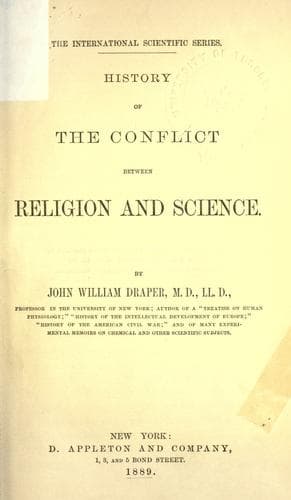
History of the Conflict Between Religion and ScienceDraper, John William
Religion
History of the Conflict Between Religion and Science
Draper, John William
Religion and science -- History
DISSENSIONS OF THE ARABS. But, though Mohammedanism had not reached its
culmination, the dominion of the khalifs had. Not the sword of Charles
Martel, but the internal dissension of the vast Arabian Empire, was the
salvation of Europe. Though the Ommiade Khalifs were popular in Syria,
elsewhere they were looked upon as intruders or usurpers; the kindred
of the apostle was considered to be the rightful representative of his
faith. Three parties, distinguished by their colors, tore the khalifate
asunder with their disputes, and disgraced it by their atrocities. The
color of the Ommiades was white, that of the Fatimites green, that of
the Abassides black; the last represented the party of Abbas, the uncle
of Mohammed. The result of these discords was a tripartite division
of the Mohammedan Empire in the tenth century into the khalifates of
Bagdad, of Cairoan, and of Cordova. Unity in Mohammedan political action
was at an end, and Christendom found its safeguard, not in supernatural
help, but in the quarrels of the rival potentates. To internal
animosities foreign pressures were eventually added and Arabism, which
had done so much for the intellectual advancement of the world, came to
an end when the Turks and the Berbers attained to power.
The Saracens had become totally regardless of European opposition--they
were wholly taken up with their domestic quarrels. Ockley says with
truth, in his history: "The Saracens had scarce a deputy lieutenant or
general that would not have thought it the greatest affront, and such
as ought to stigmatize him with indelible disgrace, if he should have
suffered himself to have been insulted by the united forces of all
Europe. And if any one asks why the Greeks did not exert themselves
more, in order to the extirpation of these insolent invaders, it is a
sufficient answer to any person that is acquainted with the characters
of those men to say that Amrou kept his residence at Alexandria, and
Moawyah at Damascus."
As to their contempt, this instance may suffice: Nicephorus, the Roman
emperor, had sent to the Khalif Haroun-al-Raschid a threatening
letter, and this was the reply: "In the name of the most merciful God,
Haroun-al-Raschid, commander of the faithful, to Nicephorus, the Roman
dog! I have read thy letter, O thou son of an unbelieving mother. Thou
shalt not hear, thou shalt behold my reply!" It was written in letters
of blood and fire on the plains of Phrygia.
Public-domain text, read in full here on John Shaqi.
Reviews
Reviews
No reviews yet
Be the first to share your thoughts on this work.
Elsewhere in the archive
Join the Discussion
Join the discussion
Sign in to leave a comment or review.
Sign InorCreate an account