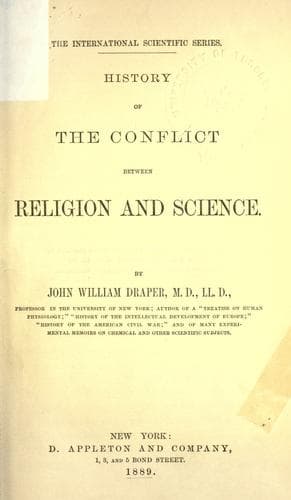
History of the Conflict Between Religion and ScienceDraper, John William
Religion
History of the Conflict Between Religion and Science
Draper, John William
Religion and science -- History
THEIR PASSION FOR SCIENCE. It is remarkable how quickly the ferocious
fanaticism of the Saracens was transformed into a passion for
intellectual pursuits. At first the Koran was an obstacle to
literature and science. Mohammed had extolled it as the grandest of all
compositions, and had adduced its unapproachable excellence as a proof
of his divine mission. But, in little more than twenty years after his
death, the experience that had been acquired in Syria, Persia, Asia
Minor, Egypt, had produced a striking effect, and Ali the khalif
reigning at that time, avowedly encouraged all kinds of literary
pursuits. Moawyah, the founder of the Ommiade dynasty, who followed in
661, revolutionized the government. It had been elective, he made it
hereditary. He removed its seat from Medina to a more central position
at Damascus, and entered on a career of luxury and magnificence. He
broke the bonds of a stern fanaticism, and put himself forth as a
cultivator and patron of letters. Thirty years had wrought a wonderful
change. A Persian satrap who had occasion to pay homage to Omar, the
second khalif, found him asleep among the beggars on the steps of the
Mosque of Medina; but foreign envoys who had occasion to seek Moawyah,
the sixth khalif, were presented to him in a magnificent palace,
decorated with exquisite arabesques, and adorned with flower-gardens and
fountains.
THEIR LITERATURE. In less than a century after the death of Mohammed,
translations of the chief Greek philosophical authors had been made into
Arabic; poems such as the "Iliad" and the "Odyssey," being considered
to have an irreligious tendency from their mythological allusions, were
rendered into Syriac, to gratify the curiosity of the learned. Almansor,
during his khalifate (A.D. 753-775), transferred the seat of government
to Bagdad, which he converted into a splendid metropolis; he gave much
of his time to the study and promotion of astronomy, and established
schools of medicine and law. His grandson, Haroun-al-Raschid (A.D. 786),
followed his example, and ordered that to every mosque in his dominions
a school should be attached. But the Augustan age of Asiatic learning
was during the khalifate of Al-Mamun (A.D. 813-832). He made Bagdad the
centre of science, collected great libraries, and surrounded himself
with learned men.
The elevated taste thus cultivated continued after the division of the
Saracen Empire by internal dissensions into three parts. The Abasside
dynasty in Asia, the Fatimite in Egypt, and the Ommiade in Spain, became
rivals not merely in politics, but also in letters and science.
Public-domain text, read in full here on John Shaqi.
Reviews
Reviews
No reviews yet
Be the first to share your thoughts on this work.
Elsewhere in the archive
Join the Discussion
Join the discussion
Sign in to leave a comment or review.
Sign InorCreate an account