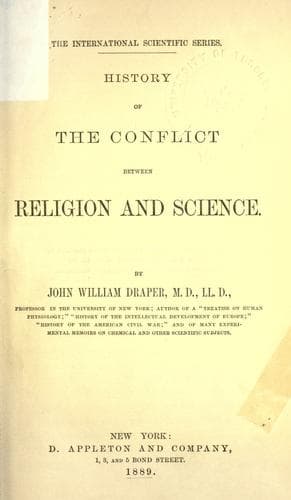
History of the Conflict Between Religion and ScienceDraper, John William
Religion
History of the Conflict Between Religion and Science
Draper, John William
Religion and science -- History
THEIR GREAT LIBRARIES. For the establishment and extension of the public
libraries, books were sedulously collected. Thus the khalif Al-Mamun
is reported to have brought into Bagdad hundreds of camel-loads of
manuscripts. In a treaty he made with the Greek emperor, Michael III.,
he stipulated that one of the Constantinople libraries should be given
up to him. Among the treasures he thus acquired was the treatise of
Ptolemy on the mathematical construction of the heavens. He had it
forthwith translated into Arabic, under the title of "Al-magest." The
collections thus acquired sometimes became very large; thus the Fatimite
Library at Cairo contained one hundred thousand volumes, elegantly
transcribed and bound. Among these, there were six thousand five hundred
manuscripts on astronomy and medicine alone. The rules of this library
permitted the lending out of books to students resident at Cairo. It
also contained two globes, one of massive silver and one of brass; the
latter was said to have been constructed by Ptolemy, the former cost
three thousand golden crowns. The great library of the Spanish khalifs
eventually numbered six hundred thousand volumes; its catalogue alone
occupied forty-four. Besides this, there were seventy public libraries
in Andalusia. The collections in the possession of individuals were
sometimes very extensive. A private doctor refused the invitation of a
Sultan of Bokhara because the carriage of his books would have required
four hundred camels.
There was in every great library a department for the copying or
manufacture of translations. Such manufactures were also often an
affair of private enterprise. Honian, a Nestorian physician, had an
establishment of the kind at Bagdad (A.D. 850). He issued versions of
Aristotle, Plato, Hippocrates, Galen, etc. As to original works, it was
the custom of the authorities of colleges to require their professors
to prepare treatises on prescribed topics. Every khalif had his own
historian. Books of romances and tales, such as "The Thousand and One
Arabian Nights' Entertainments," bear testimony to the creative fancy
of the Saracens. Besides these, there were works on all kinds of
subjects--history, jurisprudence, politics, philosophy, biographies not
only of illustrious men, but also of celebrated horses and camels. These
were issued without any censorship or restraint, though, in later times,
works on theology required a license for publication. Books of reference
abounded, geographical, statistical, medical, historical dictionaries,
and even abridgments or condensations of them, as the "Encyclopedic
Dictionary of all the Sciences," by Mohammed Abu Abdallah. Much pride
was taken in the purity and whiteness of the paper, in the skillful
intermixture of variously-colored inks, and in the illumination of
titles by gilding and other adornments.
Public-domain text, read in full here on John Shaqi.
Reviews
Reviews
No reviews yet
Be the first to share your thoughts on this work.
Elsewhere in the archive
Join the Discussion
Join the discussion
Sign in to leave a comment or review.
Sign InorCreate an account