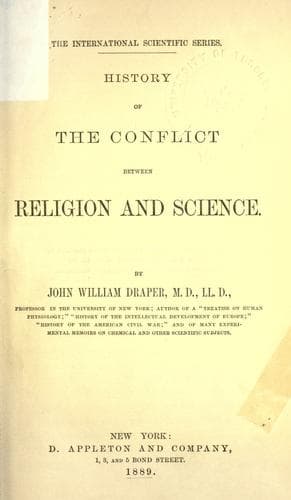
History of the Conflict Between Religion and ScienceDraper, John William
Religion
History of the Conflict Between Religion and Science
Draper, John William
Religion and science -- History
In the experimental sciences, they originated chemistry; they discovered
some of its most important reagents--sulphuric acid, nitric acid,
alcohol. They applied that science in the practice of medicine, being
the first to publish pharmacopoeias or dispensatories, and to include in
them mineral preparations. In mechanics, they had determined the laws
of falling bodies, had ideas, by no means indistinct, of the nature of
gravity; they were familiar with the theory of the mechanical powers. In
hydrostatics they constructed the first tables of the specific gravities
of bodies, and wrote treatises on the flotation and sinking of bodies
in water. In optics, they corrected the Greek misconception, that a
ray proceeds from the eye, and touches the object seen, introducing
the hypothesis that the ray passes from the object to the eye. They
understood the phenomena of the reflection and refraction of light.
Alhazen made the great discovery of the curvilinear path of a ray of
light through the atmosphere, and proved that we see the sun and moon
before they have risen, and after they have set.
AGRICULTURE AND MANUFACTURE. The effects of this scientific activity are
plainly perceived in the great improvements that took place in many
of the industrial arts. Agriculture shows it in better methods of
irrigation, the skillful employment of manures, the raising of improved
breeds of cattle, the enactment of wise codes of rural laws, the
introduction of the culture of rice, and that of sugar and coffee. The
manufactures show it in the great extension of the industries of silk,
cotton, wool; in the fabrication of cordova and morocco leather, and
paper; in mining, casting, and various metallurgic operations; in the
making of Toledo blades.
Public-domain text, read in full here on John Shaqi.
Reviews
Reviews
No reviews yet
Be the first to share your thoughts on this work.
Elsewhere in the archive
Join the Discussion
Join the discussion
Sign in to leave a comment or review.
Sign InorCreate an account