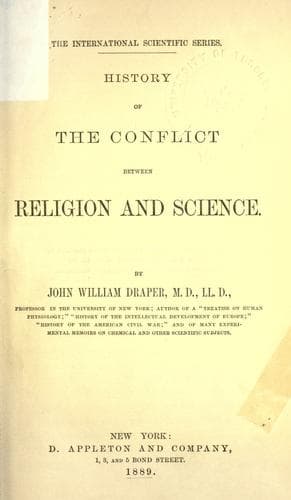
History of the Conflict Between Religion and ScienceDraper, John William
Religion
History of the Conflict Between Religion and Science
Draper, John William
Religion and science -- History
Vedaism developed itself into Buddhism, which has become the faith of
a majority of the human race. This system acknowledges that there is a
supreme Power, but denies that there is a supreme Being. It contemplates
the existence of Force, giving rise as its manifestation to matter. It
adopts the theory of emanation and absorption. In a burning taper it
sees an effigy of man--an embodiment of matter, and an evolution of
force. If we interrogate it respecting the destiny of the soul, it
demands of us what has become of the flame when it is blown out, and in
what condition it was before the taper was lighted. Was it a nonentity?
Has it been annihilated? It admits that the idea of personality which
has deluded us through life may not be instantaneously extinguished at
death, but may be lost by slow degrees. On this is founded the doctrine
of transmigration. But at length reunion with the universal Intellect
takes place, Nirwana is reached, oblivion is attained, a state that has
no relation to matter, space, or time, the state into which the departed
flame of the extinguished taper has gone, the state in which we were
before we were born. This is the end that we ought to hope for; it is
reabsorption in the universal Force--supreme bliss, eternal rest.
Through Aristotle these doctrines were first introduced into Eastern
Europe; indeed, eventually, as we shall see, he was regarded as the
author of them. They exerted a dominating influence in the later period
of the Alexandrian school. Philo, the Jew, who lived in the time of
Caligula, based his philosophy on the theory of emanation. Plotinus
not only accepted that theory as applicable to the soul of man, but as
affording an illustration of the nature of the Trinity. For, as a beam
of light emanates from the sun, and as warmth emanates from the beam
when it touches material bodies, so from the Father the Son emanates,
and thence the Holy Ghost. From these views Plotinus derived a practical
religious system, teaching the devout how to pass into a condition of
ecstasy, a foretaste of absorption into the universal mundane soul.
In that condition the soul loses its individual consciousness. In like
manner Porphyry sought absorption in or union with God. He was a Tyrian
by birth, established a school at Rome, and wrote against Christianity;
his treatise on that subject was answered by Eusebius and St. Jerome,
but the Emperor Theodosius silenced it more effectually by causing all
the copies to be burnt. Porphyry bewails his own unworthiness, saying
that he had been united to God in ecstasy but once in eighty-six years,
whereas his master Plotinus had been so united six times in sixty years.
A complete system of theology, based on the theory of emanation, was
constructed by Proclus, who speculated on the manner in which absorption
takes place: whether the soul is instantly reabsorbed and reunited in
the moment of death, or whether it retains the sentiment of personality
Public-domain text, read in full here on John Shaqi.
Reviews
Reviews
No reviews yet
Be the first to share your thoughts on this work.
Elsewhere in the archive
Join the Discussion
Join the discussion
Sign in to leave a comment or review.
Sign InorCreate an account