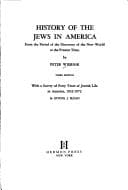
History of the Jews in America: From the Period of the Discovery of the New World to the Present TimeWiernik, Peter
History
History of the Jews in America: From the Period of the Discovery of the New World to the Present Time
Wiernik, Peter
Jews -- America -- History; Jews -- United States -- History
In the following year Count Mirabeau (1749–91) the most distinguished
of the advocates of Jewish emancipation in France, calls attention in
his essay _On Moses Mendelssohn and the Political Reform of the Jews_
(1787) to the striking similarity of the enactment of Virginia to
the conclusions at which the Jewish philosopher of Berlin arrived by
abstract reasoning; assuming that Mendelssohn never saw the preamble
of the American law, which was drafted by Jefferson four years before
the publication of “Jerusalem” in 1783. It is clear, however, that
about seven years later, when the great French Revolution, which
was influenced by the American Revolution much more than is commonly
supposed, was in full swing, even the debates of the Constitutional
Convention of Virginia of 1776 had become known to the friends of
religious liberty in France. In the course of a petition in favor of
their own emancipation, addressed by the French Jews to the National
Assembly on January 29th, 1790, they said: “America, to which politics
will owe so many useful lessons, has rejected the word toleration from
its code, as a term tending to compromise individual liberty and to
sacrifice certain classes of men to other classes. To tolerate is,
in fact, to suffer that which you could, if you wish, prevent and
prohibit.”
There were not many Jews in Virginia in the time when this momentous
question was discussed and solved. Individual Jews are mentioned in the
Seventeenth Century, but the first record of a congregation occurs in
connection with the address to Washington, mentioned above (page 102),
which was sent by the Hebrew congregations of Philadelphia, Richmond,
New York and Charleston. The minute-book of the Congregation Bet Shalom
of Richmond, Va., dates back to the year 1791, and it is assumed that
the first or Sephardic congregation was organized in that year. The
first place of worship was in a room of a three-story brick building on
the west side of 19th street, between Franklin and Grace streets, where
one of the members resided. It later moved to a small brick building,
erected on the west side of 19th street in the rear of the Union Hotel,
which then stood on the corner of Main street. After some years a lot
was purchased from Dr. Adams on the east side of Mayo street, above
Franklin street, on which a commodious synagogue was erected, in which
the congregation worshipped for upwards of three-quarters of a century.
The burial ground on Franklin street, near 21st street, which is now
enclosed with a substantial granite wall, was conveyed by Isaiah Isaac
to Jacob I. Cohen, Israel I. Cohen, David Isaac, Moses Mordecai, Jacob
I. Cohen, Jr., Simon Gratz, Aaron Levy, Moses Jacob and Levy Myers,
as trustees, on October 21st, 1791. It was used until about 1816, when
Benjamin Wolfe, then a member of the Common Council of the City of
Richmond, made application on behalf of the congregation for a new
piece of ground, which was granted by an ordinance passed on the 20th
Public-domain text, read in full here on John Shaqi.
Reviews
Reviews
No reviews yet
Be the first to share your thoughts on this work.
Elsewhere in the archive
Join the Discussion
Join the discussion
Sign in to leave a comment or review.
Sign InorCreate an account